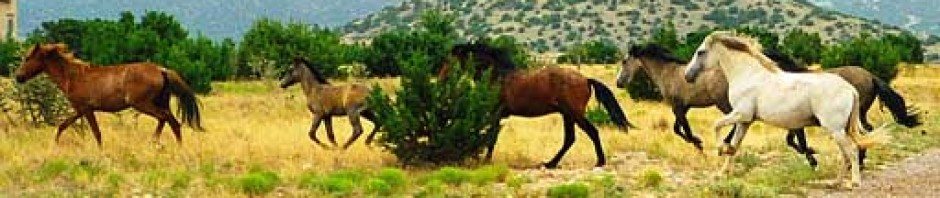
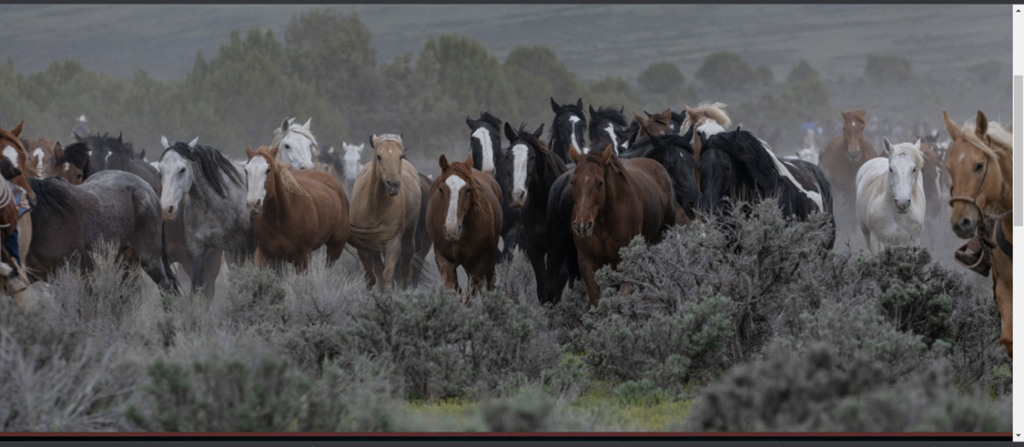
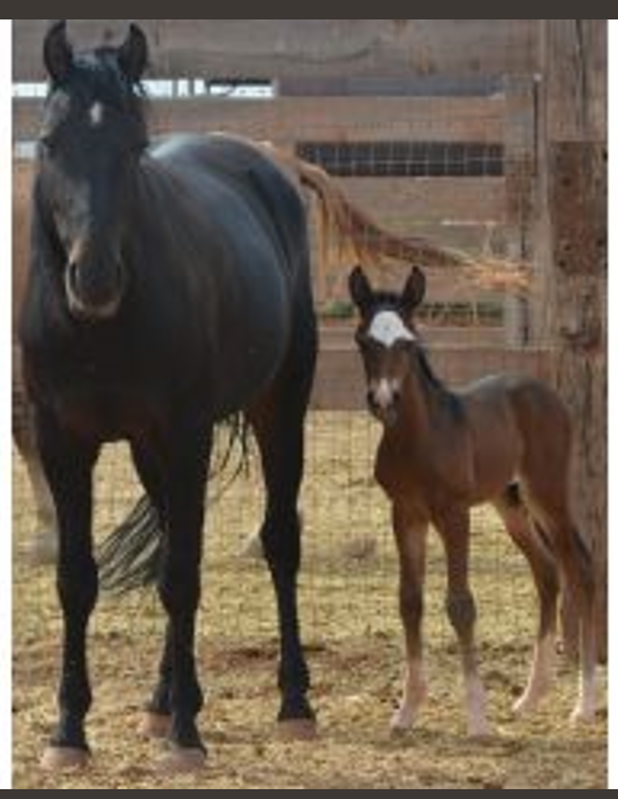
Pictures of our Legally Protected Wild Horses of Placitas family of Bay Mare Placitans call Coral at Center, hit for a cause. (Collage of pictures taken by Placitans who knew this mare and her family.)
AFFIDAVIT
I, Patience O’Dowd of Sandoval County NM, do swear under penalty of perjury that the following statements are true to the best of my understanding and recollection.
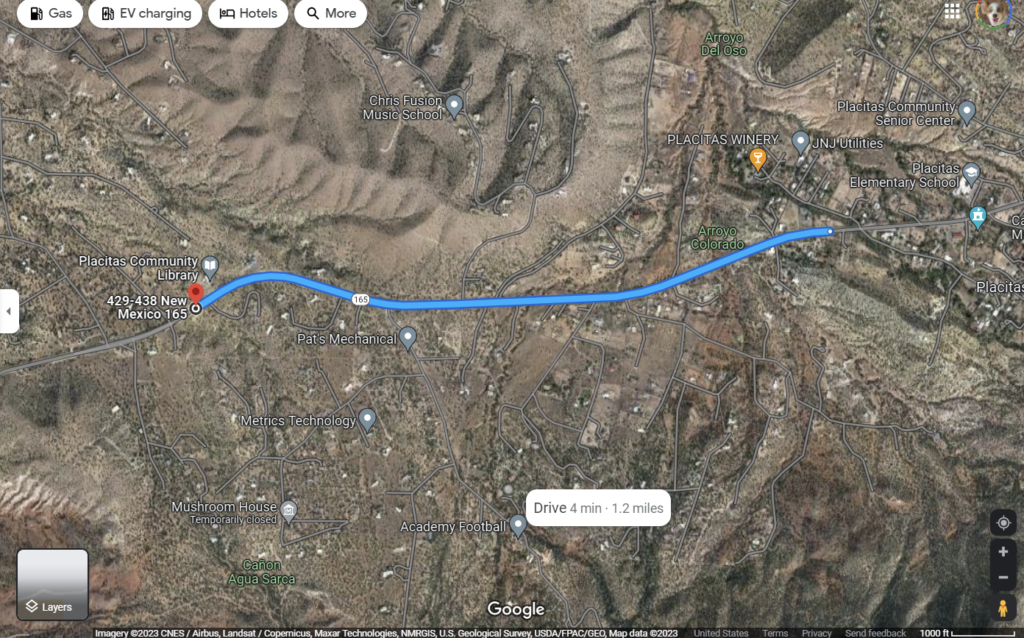
On 1/19/23, I arrived at the scene of an alleged accident or crash site near the library in Placitas on rt 165 at about 8:20 AM. Upon information and belief, I believe that the vehicle that hit the horse was a dually truck and that it was a hit and run. (Dually: Double tires in the back.)
The police report and pics appear to show that either they were mis-led or that they were complicit in a false report.
The following data is pictorial documentation.
A WILD HORSE WAS HIT ON RT 165 1/19/2023
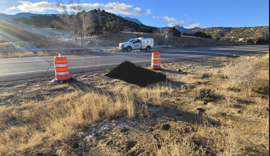
This is the scene which I arrived to at 8:20M after receiving a call from Mr. Gary Miles AT 7:52 AM on 1/19/23.
Gary Miles stated to me that he had received a number of calls that morning. Two of which were from the County and he was asked to come and pick up a dead wild horse.
Gary did come and pick up the mare.
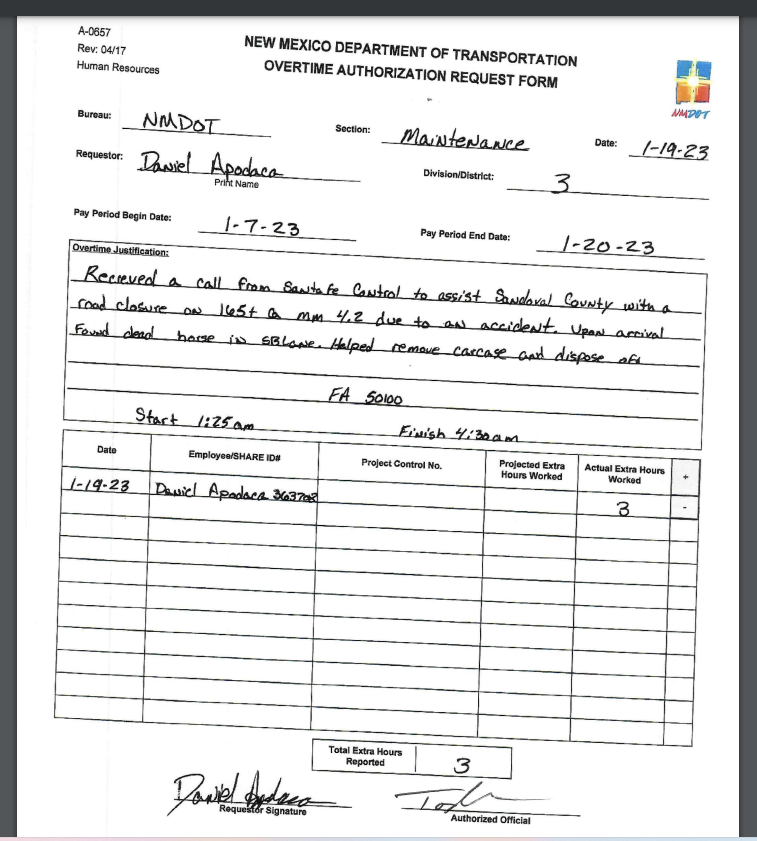
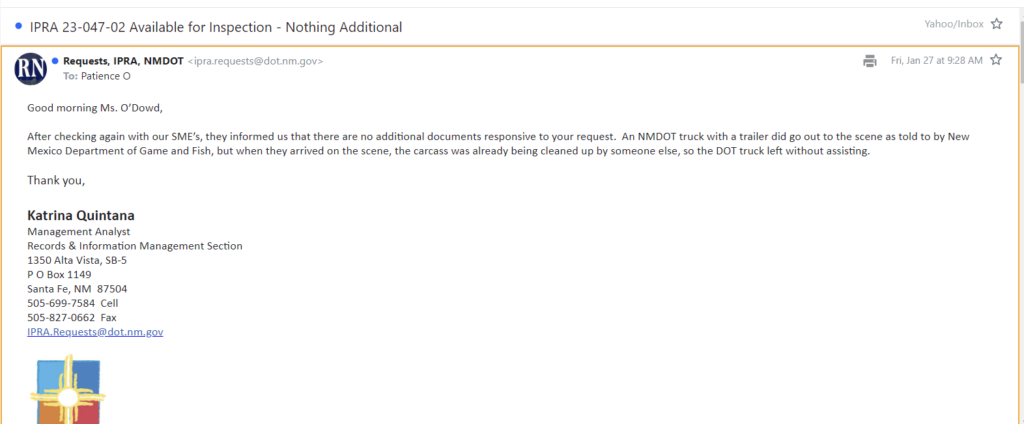
NMDOT public records state they picked up the mare. See Exhibits after signature from inspection of public records requests to NMDOT.
The wild horse, a mare, was allegedly hit at 12 or 12:30AM 1/19/23.
Blacked our Wild Mare out od respect.
I blacked out the wild horse out of respect.
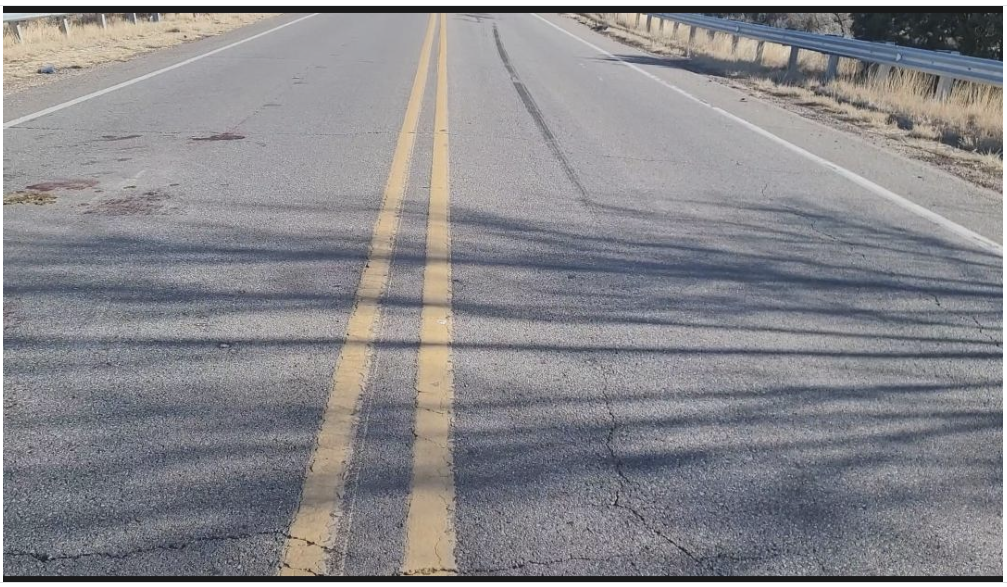
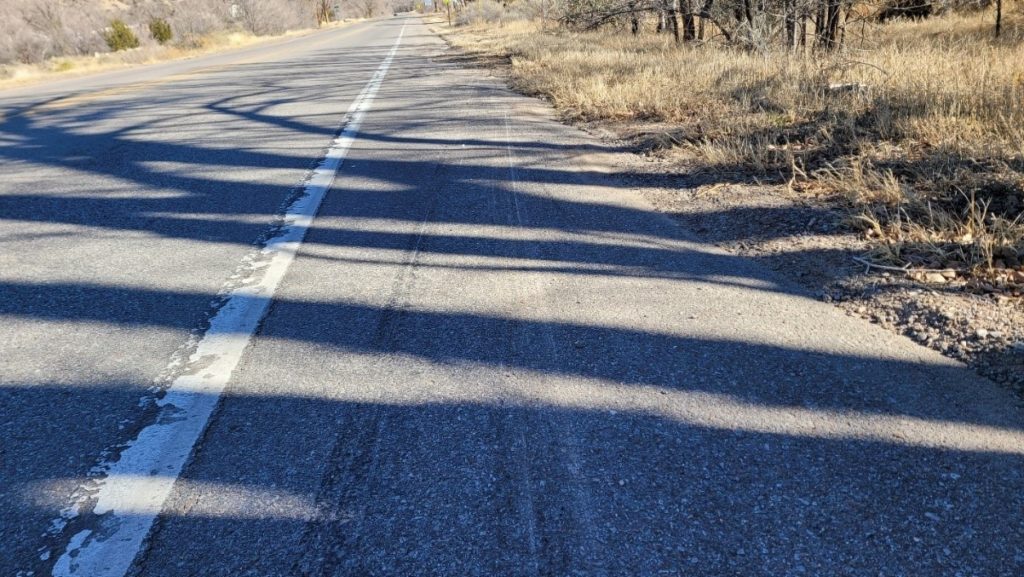
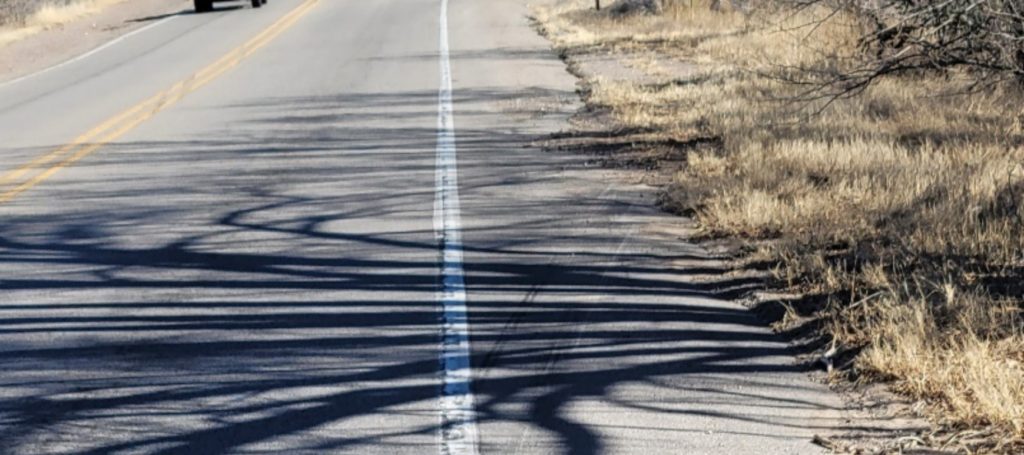
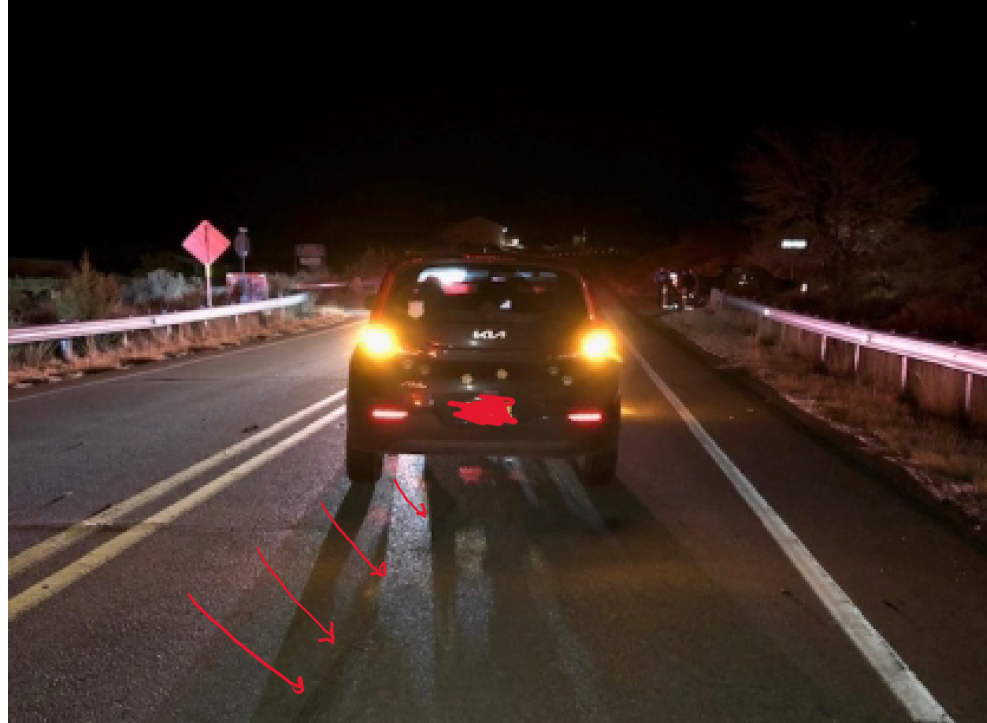
THE VEHICLE THAT HIT THE HORSE PER THE TIRE MARKS WAS A DUALLY TRUCK.
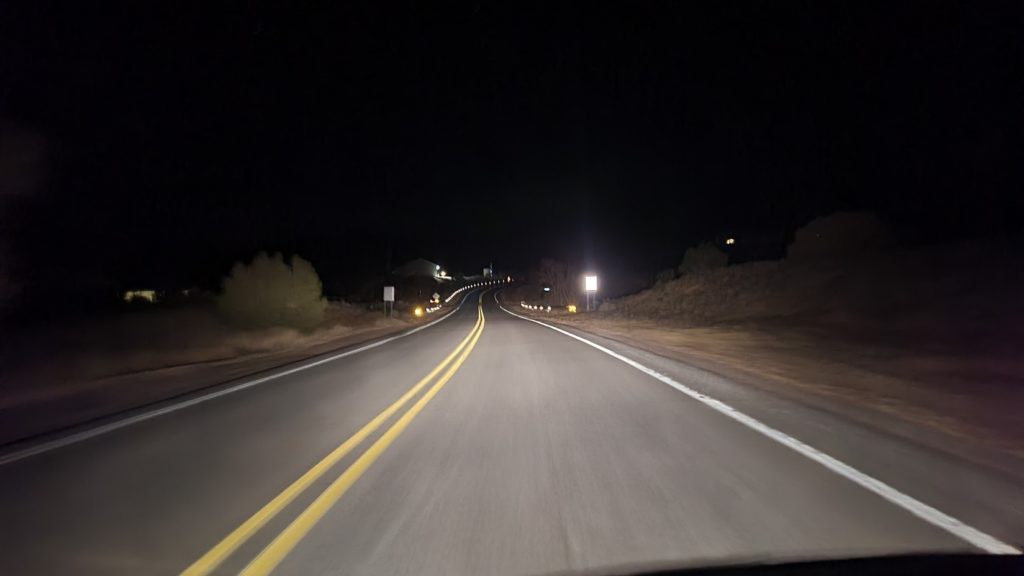
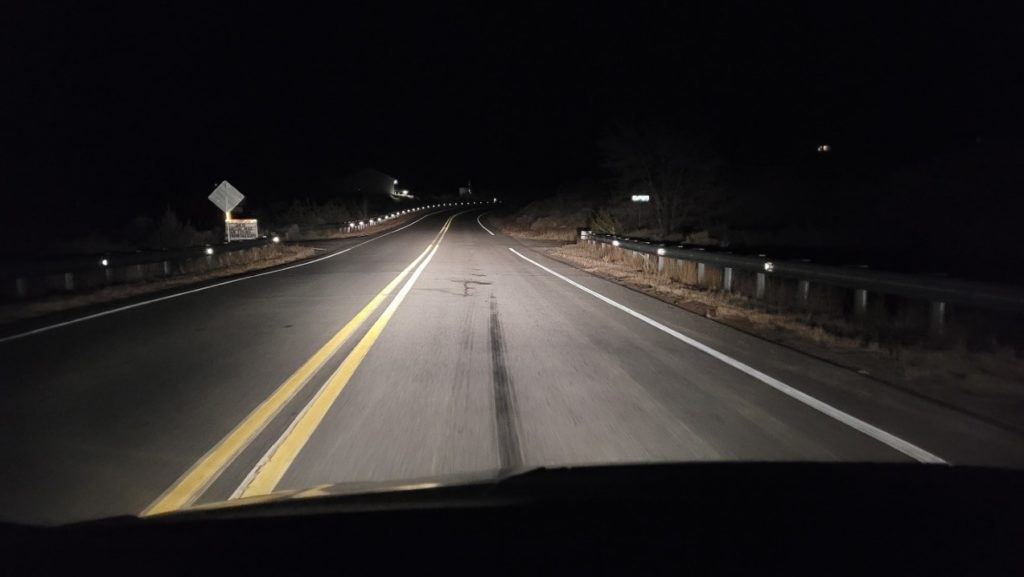
THIS AREA HAS GREAT VISIBILITY AT NIGHT DUE TO BEING SLIGHTLY UPHILL WITH MUCH REFLECTIVE GUARDRAILS AND SIGNAGE (NEAR THE LIBRARY) AS BACK DROP AT NIGHT. SEE BELOW.
THE DUALLY WAS HEADING EAST. ITS LEFT SIDE TIRES HAD CROSSED THE DOUBLE YELLOW LINE AND HIT THE HORSE.
THE TIRE MARKS ARE NINETYONE (91) FEET LONG BETWEEN THE HORSE’S BODY AND THE RADIATOR FLUID.
THIS GIVES AN INDICATION THAT SPEED WAS LIKELY INVOLVED.
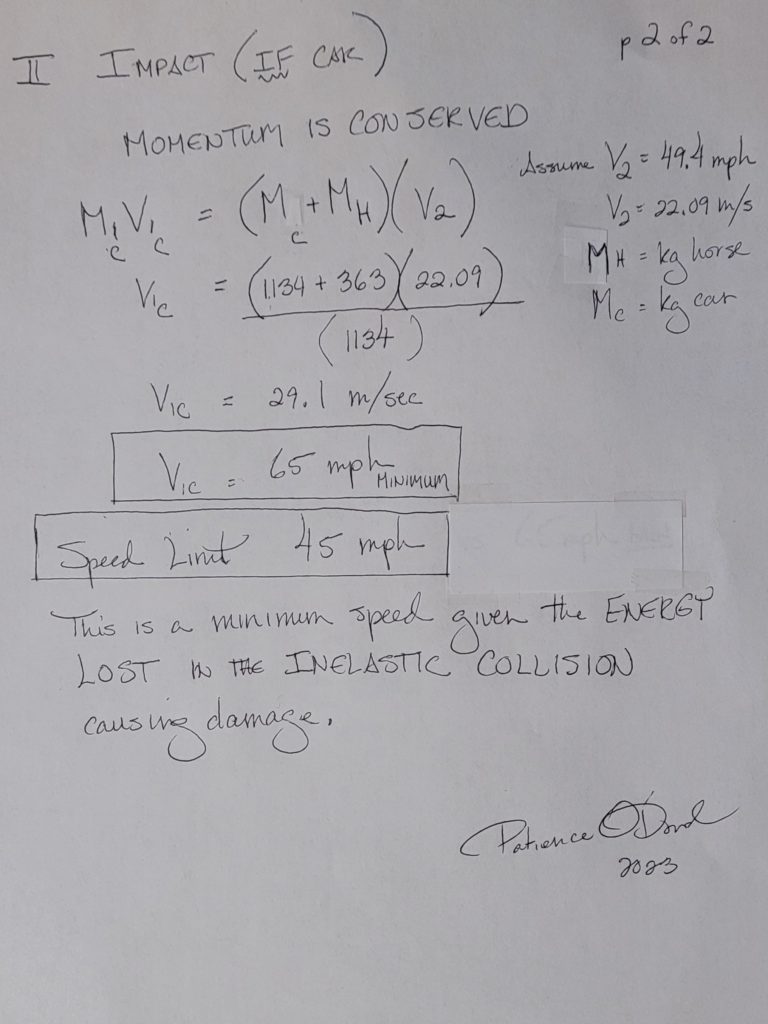
SUPPLEMENTAL CALCULATION BY HAND CONFIRMS (SEE BOTTOM) SHOWS A SPEED OF 65mph in a 45mph. (More accurate than possible speed from online calculator.)
IT IS NOTABLE THAT THERE ARE NO SKID MARKS PRIOR TO HITTING THE HORSE.
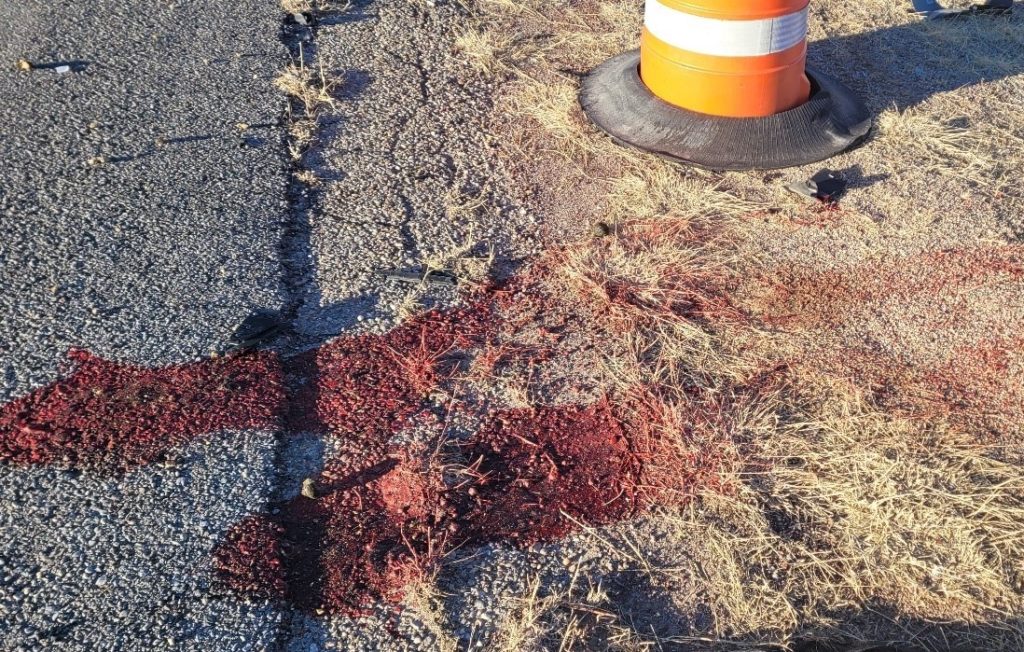
The wild horse was just to the left off the road next to the blood marks shown here.
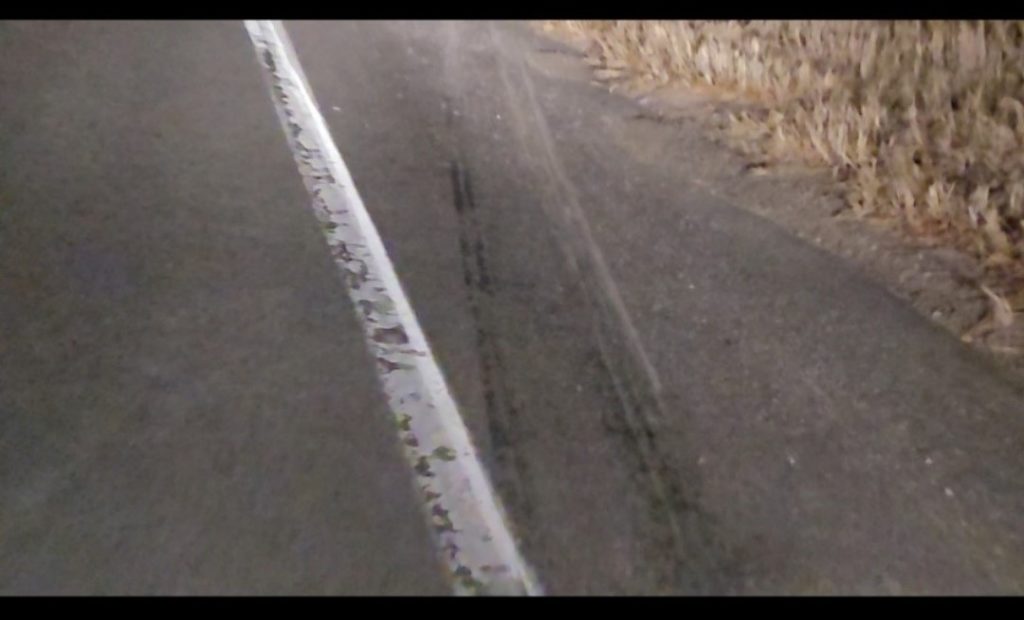
THIS IS WHAT THE TRACKS LOOKED LIKE AT NIGHT.
Dually skid mark night view
– AGAIN, GREAT VISIBILITY HERE
– THIS HORSE RUNS IN A EASILY VISIBLE AND COLORFUL HERD, THOUGH IT IS BROWN.
– THERE ARE BOTH WILDLIFE AND WILD HORSE CAUTION SIGNAGE ON RT165.
These horses are protcted wildlife, a natural resource of Placitas New Mexico, per 2007 legislation NMSA 77-18-5 (and therefore also the NM Animal Cruelty Law), passed by Senator Komadina with the Wild Horse Observers Association unanimous minus 1.
It is a crime to intentionally harm a protected wild horse, a NM state’s natural resource.
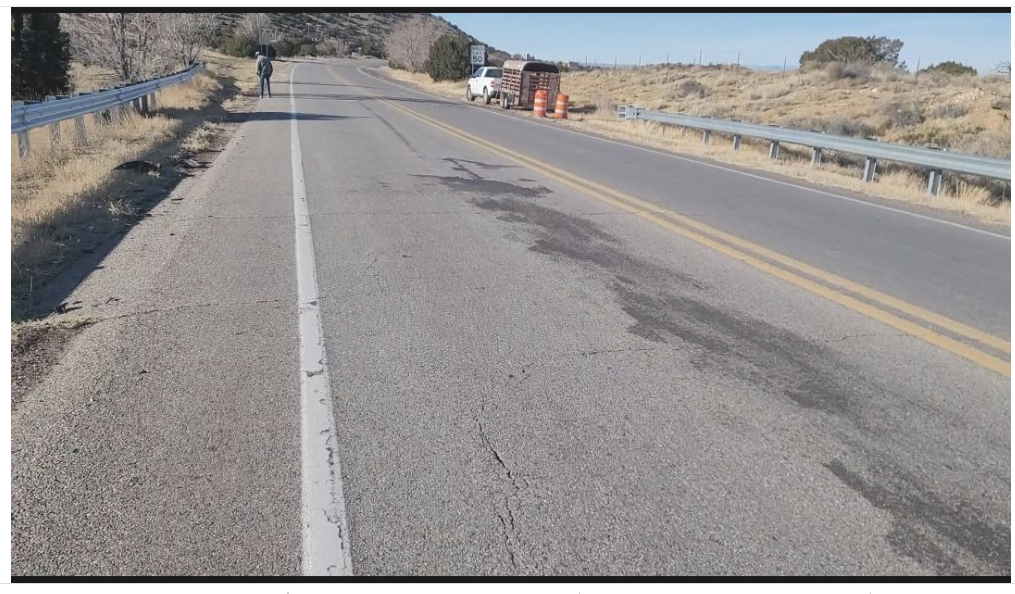
GARY MILES LOADED THE HORSE OFF THE SIDE OF THE ROAD AT ABOUT 8:30AM 1/19/23 SEEN HERE.
Radiator/fluids were tracked down the street by traffic. Not well cleaned up by NMDOT and Sandoval County though antifreeze is lethal for animals.
THE MARE HAD BEEN EUTHANIZED AS SHOWN BY THE AFFECTS AT THE SCENE.
THE POLICE ALSO STATE THAT IN THEIR REPORT THAT THEY EUTHANIZED THE MARE.
THE DUALLY LEFT THE SCENE WHICH IS ILLEGAL BUT MADE IT ONLY 1.6 MILES TO THE 35MPH SPEED LIMIT SIGN ENTERING THE VILLAGE OF PLACITAS BEFORE PULLING OFF THE ROAD IN A SPOT FOLKS DO NOT NORMALLY PULL OVER AND PARK.
THE DUALLY TRUCK PULLED OFF THE ROAD, ITS RIGHT REAR TIRES LOCKING UP AGAIN AS SEEN BY TIRE MARKS ABOVE.
POSSIBLY OVER HEATING DUE TO THE CRASH.
HERE THE DUALLY TRUCK WENT INTO THE MUD OFF THE ROAD
THE TRACKS SHOW UP WELL WITHOUT TREE SHADOWS AT NIGHT. THIS WAS THE BACK RIGHT TIRES ALSO AS CONFIRMED WITH THE LEFT REAR TIRES SHOWING UP IN THE DIRT BUT NOT LOCKING UP.
THE DUALLY CAME TO A STOP WITH BACK RIGHT TIRES STILL LOCKING UP IN THE SECOND MUD PATCH OFF THE ROAD.
THE EVIDENCE DOES NOT SUPPORT THE POLICE REPORT:
I. THE CAR APPEARS TO HAVE BEEN PRE-STAGED. IT MAY HAVE ACCIDENTALLY HIT AN UNGULATE ELSEWHERE (COW, ELK, ETC.) AND PLACED THERE AFTER THE DUALLY TRUCK PROVIDED A SAFER WAY TO HIT A HORSE FOR LEGISLATIVE PURPOSES. THIS IS HIGHLY PLAUSIBLE GIVEN THAT OTHER ACTUAL ACCIDENTS IN PLACITAS WITHOUT A HORSE INVOLVED HAVE BEEN UTILIZED BY THE LAND GRANT, AFTER THE FACT, TO BLAME THE WILD HORSES.):
THE PHOTO OF THE CAR IN THE POLICE REPORT WAS IN FACT NOT IN-LINE WITH ANY TIRE MARKS.
THE ONLY TIRE MARKS ARE FROM THE DUALLY TRUCK.
HOWEVER, THE POLICE REPORT STATES (Crash no. 710496477, Case no. 23000097):
“THE DAMAGE TO THE VEHICLE AND THE TIRE MARKINGS PRESENT ON THEGROUND WERE CONSISTENT WITH (Name Redacted) STORY OF THE INCIDENT.”
DUALLY MARKS NOT EVIDENT AT THE START BUT ARE CLEAR AT THE END AND ARE UNDERNEATH THE CAR.
THIS CAR A 2022, LIKELY HAS ABS BRAKES WHICH SUPPOSEDLY SHORTEN STOPPING DISTANCE.
SPEED WAS VERY LIKELY INVOLVED PER THE LENGTH OF THE TIRE MARKS VERSUS (NAME REDACTED) STATED SHE WAS DRIVING AT APPROXIMATELY 50 MILES PER HOUR AND ATTEMPTED TO BREAK BEFORE STRIKING THEHORSE.
I ALSO DO NOT BELIEVE THE DRIVER OF THE DUALLY TRUCK HIT THE BRAKES BEFORE HITTING THE HORSE THERE IS NO SIGN OF THAT IN THE ROAD, CONSISTENT WITH IT BEING A PURPOSEFUL ACT.
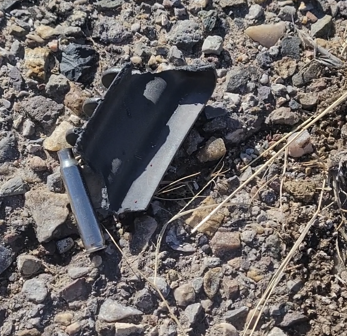
THE PLACEMENT OR LOCATION, SIZE, AND REMOVAL OF THE DEBRIS, AND THE DEBRIS FROM THE CAR ITSELF, ALSO DO NOT MAKE SENSE, (OF WHICH I HAVE VIDEO AND PICTURES) THOUGH MUCH OF IT HAS NOW BEEN REMOVED.
I BELIEVE IT IS LIKELY INSTEAD THAT THE TRUCK SPED UP TO HIT THE HORSE, AND AFTER HITTING THE HORSE TRIED TO SLOW DOWN TO KEEP CONTROL OF THE TRUCK.
THE COUNTY DID CALL GARY MILES, BUT NOT UNTIL MORNING.
THE DRIVER OF THE CAR HAD NO INJURIES PER THE POLICE RPORT.
THE DRIVER OF THE CAR LIVES ON THE LAND GRANT, PER THE POLICE REPORT.
II.THE NMDOT REPORT TOOK CREDIT FOR PICKING UP THE HORSE, THOUGH GARY MILES PICKED HER UP AND TOOK HER TO THE LANDFILL AS HE USUALLY DOES. HE PICKS THEM UP NO MATTER WHAT TIME AND THIS IS WELL KNOWN AS HE IS USUALLY THE ONE THAT PUTS THEM DOWN WITH POLICE PERMISSION; AGAIN NO MATTER WHAT TIME, AND I HAVE BEEN A WITNESS. See the two NMDOT Exhibits after my signature.
I BELIEVE THAT A CERTAIN FEW OF THE SANDOVAL COUNTY SHERIFF’S OFFICE AND THE NMDOT MAY BE A PARTY TO THIS, GIVEN THEIR COVER UP REGARDING INSPECTION OF PUBLIC RECORDS SINCE THE 7/27/2022 COUNTY COMMISSION MEETING AND VOTES. THE COVER UP IS REGARDING THE COUNTY COMMISSION VOTES ON 7/27/2022 AND INITIAL CONSTRUCTION OF THE FUTURE HIGHWAY CONNECTING I25 TO RT 14 AND I40.
I ALSO BELIEVE SOME AT THE SHERIFF’S OFFICE MAY BE A PARTY DUE TO THE CLEAR FACT THAT SPEED WAS INVOLVED NO MATTER WHAT VEHICLE HIT THAT HORSE IN A 45MPH AREA TO HAVE A 91 FT MARK OR COME TO A STOP 91 FEET AWAY. ANY CRASH REPORT SHOULD HAVE INCLUDED THIS FACT.
BACKGROUND
III.THE LAND GRANT STANDS TO GAIN WHEN THE WILD HORSES ARE GONE FROM THE “Buffalo Tract” BLM LANDS OF PLACITAS. (Bureau of Land Management (BLM)). VERY QUESTIONABLE BUSINESS HERE INCLUDING OUR FEDERAL AND STATE REPS AND LEGISSLATURE.
IV. THERE HAS BEEN WELL DOCUMENTED FALSE TESTIMONY BY THE LAND GRANT TO THE INDIAN AFFAIRS COMMITTEE AT LEGISLATURE, REGARDING THE BLM LANDS AND BY STATE AND THE LAND GRANT REGARDING ALLEGED WILD HORSE ACCIDENTS.
V. THERE HAVE BEEN MULTIPLE WELL DOCUMENTED FALSE WRITTEN REPORTS (NMLB ANNUAL REPORT BY TH STATE VET) BY THE STATE OF NEW MEXICO TO BOTH THE GOVERNOR OF NM AND TO THE LEGISLATURE REGARDING WILD HORSE ACCIDENTS AND THE PLACITAS LAND GRANT. THIS IS A FORTH DEGREE FELONY.
VI. THIS IS NOT THE FIRST TIME A HORSE WAS APPARENTLY INTENTIONALLY HIT (AT 70 TO 90MPH) AND THERE WAS FALSE TESTIMONY REGARDING THE MOTOR VEHICLE AND THE HORSE HIT IN THE ATTEMPT FOR INSURANCE PURPOSES. THAT PERSON WAS ALSO LIVING WITH LAND GRANT.
VII. THERE HAVE BEEN NUMEROUS FALSE STATEMENTS BY LEGISLATORS AND THE STATE AT LEGISLATURE REGARDING THE DNA TESTING OF THE PLACITAS WILD HORSES, AND THEY ARE AGAIN WORKING TO DELETE SECTION 21 OF OUR NM CONSTITUTION UNDER FALSE PRETENSES, AND FALSE ADVERTISING, SAME AS LAST SESSION AND WERE DEFEATED.
VIII. LEGISLATURE IS REPEATEDLY COMPLICIT IN ATTEMPTING TO REDEFINE WILD HORSES IN NM OUT OF EXISTENCE IN A FRAUDULENT AND CORRUPT MANNER.
THIS CRASH HAPPENED THE FIRST WEEK OF LEGISLATURE.
THE BUFFALO TRACT PROTECTION ACT VERSUS MINING ON THE PLACITAS BLM HAS NOT PASSED.
THE BLM AND THE STATE OF NM BOTH WANT GRAVEL MINING $$$ AND A HIGHWAY CONNECTING I25 AND I40 THROUGH THE PLACITAS BLM (NE CORRIDOR/LOOP RD).
THE HORSES BLOCK BOTH THE MINING AND THE HIGHWAY BECAUSE OF LACK OF DUE PROCESS BY THE BLM IN THEIR RESOURCE MANAGEMENT PLAN UPDATE FOR THE “Buffalo Tract” BLM LANDS IN PLACITAS INITIATED IN 2008.
SANDOVAL COUNTY VOTED TO START WORK ON THIS HIGHWAY ON JULY 27TH 2022 AND DID START THIS CONSTRUCTION. THE NMDOT AND SANDOVAL COUNTY HAVE BOTH WORKED TO HIDE THIS FROM THE COMMUNITY OF PLACITAS.
See Exhibits below. Further documentation mentioned above is available upon request. There is more information but I have attempted to be a brief as possible.
written 1/27/2023, updated with links 1/28/2023NMDOT states here that they picked up the carcas and disposed of it and apparently charged tax payers three hours.
Patience O’Dowd 1/27/2023
After I asked the NMDOT to re-check their records, they then admitt that they did not dispose of the horse.
THIS IS ALSO WRITTEN FOR THE SANDOVAL COUNTY WATCHDOG NEWS.INC
SUPPLEMENTAL CALCULATION of Speed – uploaded 2/20/2023 => If this was a car, which I do not believe, then the car was going 20 miles per hour over the speed limit of 45mph. If it was the Dually truck, the speed was 9.6 miles per hour over the speed limit. (Note: Only the back rt was skidding so the other wheels had good traction.)
Posted inUncategorized|Comments Off on GOVERNMENTAL PROTECTED WILD HORSE SABOTAGE IN PLACITAS NM
Hiding his cruelty behind “Indian Washing” and Green Washing.
FEDERAL WILD HORSE AND BURRO ACT was passed BECAUSE the states could not be trusted to manage the Wild Horses and Burros as Wildlife due to their GREED-driven CONFLICT OF INTEREST.
The Alpine Horses are up for bid as horses for slaughter
No one can see them in advance of a Public Auction BID.
The 1971 Federal WH&B Act was passed BUT, now the FEDS are doing the same things the states were.
Each Presidential administration has had CONFLICTS OF INTEREST and has selected Secretaries of the Interior and U.S. Department of Agriculture with CONFLICTS OF INTEREST to the Nation’s Native Wild Horse. We believe largely due to the FARM Bill Kickbacks since 1933.
They have, in turn, brutally and negligently mis-managed the wild horses and burros they were requiredto protect from Conflicts of INTERESTS.
Adding insult to INJURY, in the last decade two state’s Governors, of Utah (since 2017) and New Mexico (since 2013), have worked with the federal government to SCAPEGOAT FIRST PEOPLES, especially Navajos, for the eradication and slaughter of the nation’s native Wild Horses.
Why? Because no US politician wants it known that they are acting against the will of 80% of Americans. This way they can blame and proclaim that “First Peoples are Sovereign,” so, “it’s out of my hands!” but, “I Love Horses!”
Now comes Arizona’s second term Governor Ducey. He refuses to protect the Alpine horses unlike his protection of the Salt River horses. He too joins the blame game.
He has the fiduciary responsibility to protect as Az state’s wildlife (17-101,17-102 and more). Instead, he colluded with the feds to round them upillegally as trespass livestock.
But the Alpine Wild Horses DO NOT meet the Federal Definition’s criteria for “Livestock.” 29 CFR Section 780.328
These wild horses have been illegally rounded up and are at risk, or are being sent, to cruel and illegal shipment and slaughter through Mexico, right down route Az Rt191, to LIVE shipments around the globe (per United Nations data obtained by WHOA).
JUSTIFYING THE SLAUGHTER
Governor Ducey and the Forest Service are apparently hiding behind the stamp of approval from both the USDA FS Region 3 Veterinarian, who hails from the Laguna Pueblo and the Center for Biologic Diversity.
INDIAN WASHING
“A SAVAGE IS NOT ONE THAT LIVES IN THE FOREST, A SAVAGE IS THE ONE THAT DESTROYS IT” Unknown, quoted by Ron Toahani Jackson (Navajo)
However, sadly, Governor Ducey, USDA FS Region 3, and the Department of Interior, are hiding behind the faces of a few First Peoples, (notably women) attempting to scapegoat all Sovereigns for the massive round ups, eradication, and slaughter, of our nation’s native wild horses, including the Az state’s Alpine Wild Horses.
We are calling it “Indian-Washing,” it’s just like “Green-Washing!”
Meet Dr. Tolani Francisco DVM (Laguna Pueblo) wild horse and burro coordinator for the U.S.D.A. Forest Service Region 3.
She took this position so she could “properly represent the horses!”
However, during the UTAH Wild Horse and Burro Advisory Board Meeting of 2018, https://www.blm.gov/sites/blm.gov/files/wildhorse_2018AdvBrdMtgSLC_roughcuttranscripts.pdf,
and in her current “coming out” video at: 2022 Alumni Fellow – Dr. Tolani Francisco, DVM 1990.,Dr. Francisco advocates for using “ALL THE TOOLS” (meaning lethal ones) for “managing” wild horses and burros and blames the “tribes”.
Dr. Francisco strongly implies that on this matter she is speaking for all the tribes, but she names no names!(See minutes 34 – 39.)
Ms. Francisco does not speak for the Navajo or any other Nation. She is a USDA FS veterinarian, and that is the entire extent of her authority.
Whatever the case, no one is stopping Sovereigns from wildlife management as they see fit on their Sovereign lands.
WHOA does not endorse grouping Sovereigns and throwing them all under the bus. Nor are we interested in wild horse laundering, or false-drought-engineered disaster events, such as Cameron of which WHOA has proof, and of which Dr. Francisco also refers to at the Advisory Board meeting, apparently for use as PR to push people toward slaughter, and ALL THE TOOLS.)
“We don’t have a lethal outlet for horses owned or unowned.”
“. . . we started working with New Mexico State University, Dr. Sam Smalage . . . we want to really engage the tribes in New Mexico and Arizona. . . .” There is too much here for this post but we will discuss it in another.
“We’re not able to implement all the tools in our
tool box. . . because we don’t have slaughter in
the United States any more.”
Indian Washing Alert!
Wait for it . . .
“Other tribes, I will be honest with you, are probably
doing things that people don’t want to talk about.”
From 2018 Wild Horse and Burro Advisory Board Meeting Transcripts in Utah.
“…these are tough decisions
that have to be made.”
“I wanted to make sure these horses were
being properly represented.”
Dr Francisco also states she is also studying the laws and that advocates and their lawsuits make this job hard.
WHOA has notified Governor Ducey and the USDA FS in two open letters that these Alpine Horses don’t meet the federal definition of Livestock so their categorical exclusion impoundment is not legal. We’ll re-send personally and ensure Dr. Francisco gets the letter.
We are reasonably sure per our Veterinarian Dr. Lester Friedlander a former USDA Veterinarian that these horses are in a line up for unspeakable cruelty with nothing formal safeguarding them thanks to Governor Ducey.
GREEN Washing the Slaughter of the Alpine Wild Horses
THE USDA FS is also apparently GREEN-Washing sale/slaughter of the ALPINE WILD horses behind the Center for Biologic Diversity (CBD) claims of harm to an endangered mouse.
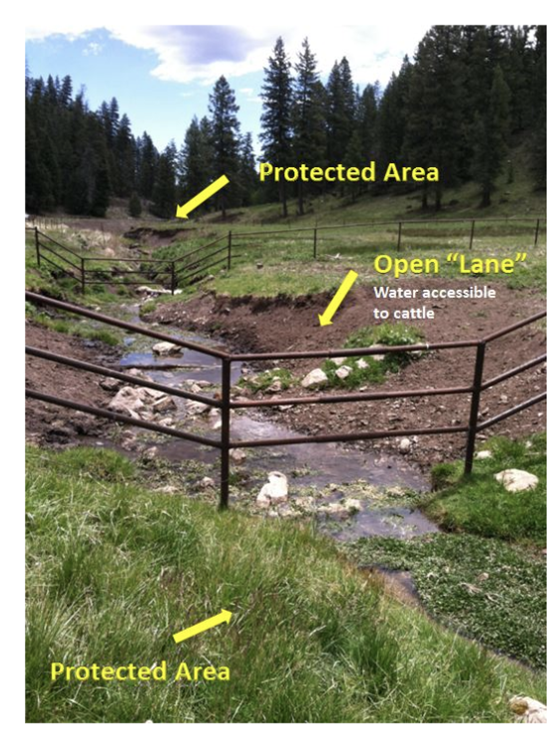
Scapegoating Alpine Wild Horses as harming an endangered mouse that already has exclosures (that they use for CATTLE) near the habitat streams.
Simple exclosures protect riparian areas and endangered mouse but allow cattle to the streams in various locations. It’s ONLY OK for CATTLE
These exclosures are ONLY OK for CATTLE who push through fences, or Elk and Deer that jump them? Unlike horses?
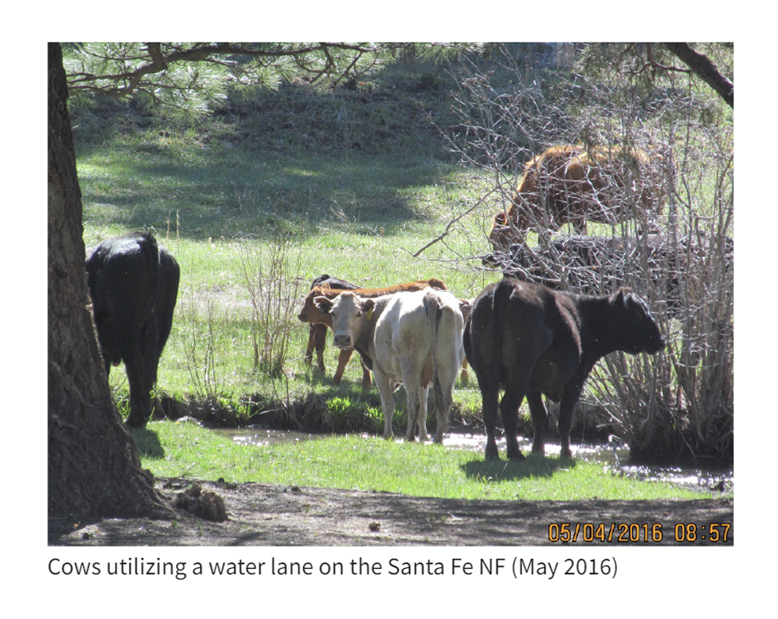
“Below are images of just some of the water gaps/lanes near exclosures on the Lincoln and Santa Fe National Forests where livestock have full access to water. Livestock have been utilizing these gaps extensively with no apparent difficulties.”
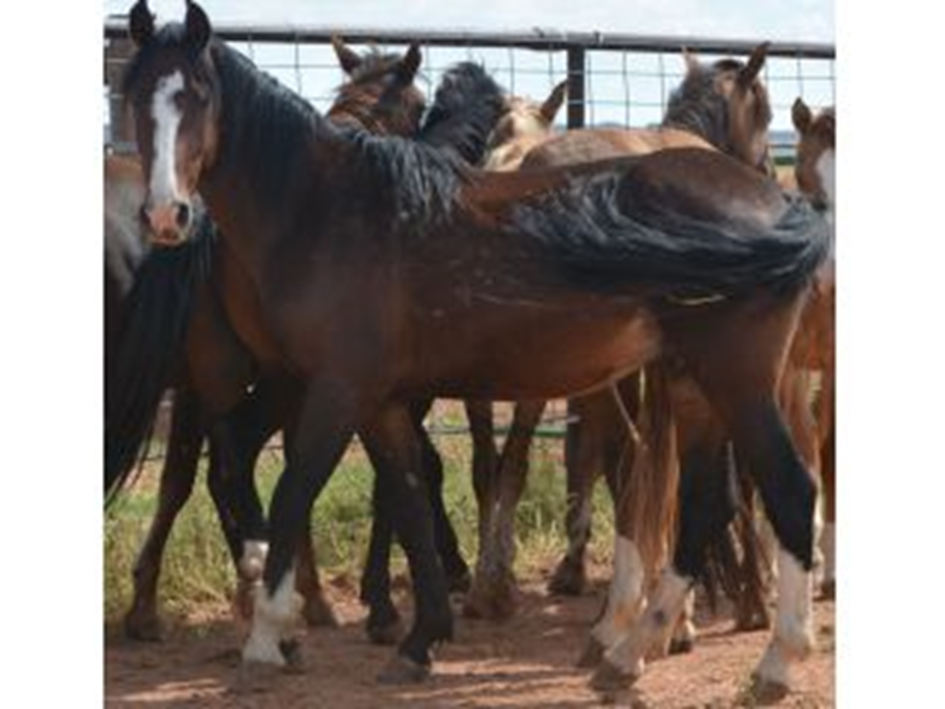
ALPINE Az Wild Horse illegally rounded up for slaughter as livestock, courtesy of Governor Ducey.
Dr. Francisco DVM does not speak for the Navajo Nation; they have a Tribal Council.
According to section 5 under natural law of the fundamental laws passed by the Navajo Tribal Council:
All Life Forms have rights
Per Ron Toahani Jackson (Navajo) 10/2/2022
The Nohooka Dine’ (Navajo Elders and Medicine People) Oppose the Navajo Roundups and horse slaughter. The Nohooka’ Dine’ Resolution states:
“The Horse is our medicine and has helped us survive many hardships, they must be given respect and honored for their sacred place within the Creation, as they possess the same fundamental right to Life as we, Five Fingered Ones do, “states the Resolution of the Nahooka Dine’, traditional Navajo medicine people opposing the slaughter of the horse.
The Resolution states, “the capture, imprisonment and proposed execution of these horses represents a forced assimilation and destruction of our spiritual and cultural way of life.”
“We recognize that the capture, imprisonment and proposed execution of these horses is the same destructive cycle of actions that Our Ancestors endured, equal in destructive impact to our cultural way of life as the slaughter of the bison.”
Nahooka Dine’ state, “The Navajo Nation of our fundamental belief and understanding of K’é. The Navajo Nation’s proposed mass execution of horses erodes this basic fundamental belief and understanding that (Peaceably) Unites Us to One Another and to All Creation.”
The UN Declaration on the Rights of Indigenous Peoples requires both the Navajo Nation and United States governments to consult with Indigenous Peoples who are guaranteed the right to free, prior and informed consent.
The Navajo Nation government’s support and involvement in horse slaughter has been described as cruel, barbaric and reckless. The practice of capturing, removing and killing horses and burros from their native lands is considered by many – a continuance of the unspeakable assimilation of children into so-called “boarding schools” when Navajo children’s hair was cut and they were forbidden to speak their Dine’ language. Those opposed to the roundups and the killing have expressed grave concern for the impact these violent activities have on Navajo children, as they promote behaviors that lead to hate, domestic violence and drug abuse. It is the view of many people that the Navajo tribal government destruction of horses is a repeat of the gruesome mass killing of wild buffalo in North America as conducted by the U.S. government and commercial hunters that resulted in the near extinction of the American bison.
“We see this mass execution of our relatives, the horses, as the rotten fruit of a bad seed that was planted in the minds of our children in the earlier days,” states the Resolution.
“Our children must be taught to value life, otherwise they will treat their own lives recklessly and be drawn toward substance abuse, domestic violence, suicide and other behaviors that are not in accordance with Our Way of Life.”
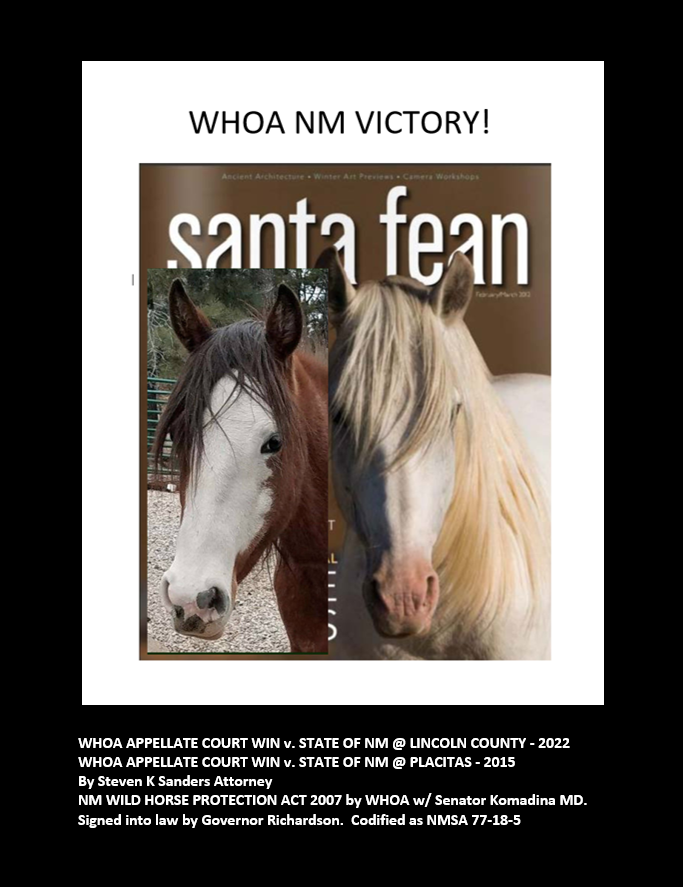
Special Thank you to Pia Gallegos Repeat Super Attorney of NM and Jordan Beckett Attorney of Oregon
Special Thank you to NM State Senator Steve Komadina MD and Governor Richardson
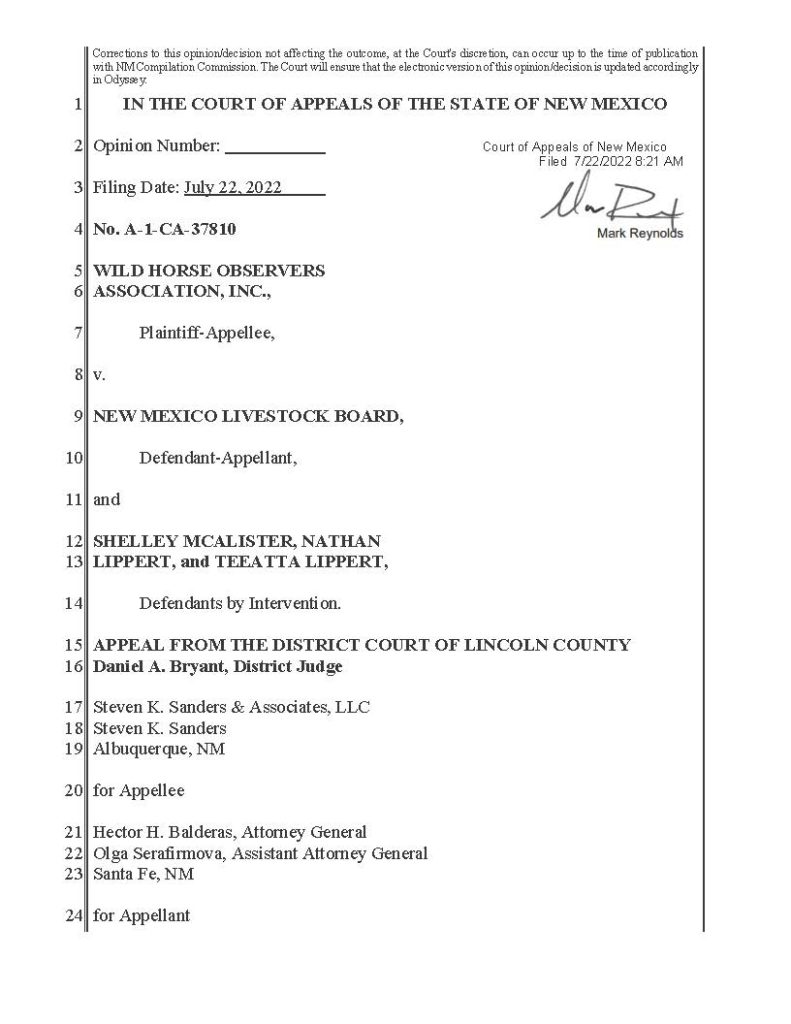
The Appellate Court Decision
“CONCLUSION We hold that wild horses whose habitat includes public lands do not lose their wild status when captured on private lands. We, therefore, affirm the district court’s order to the extent that it correctly determined that the subject horses are wild horses, and may not be treated as estray…”
Hence, no to public auction and slaughter!
Posted inUncategorized|TaggedWild Horse Observers Association|Comments Off on PRESS RELEASE: The Wild Horse Observers Association (WHOA) WINS Again v. STATE OF NEW MEXICO in the NM APPELLATE COURT. NM State’s WILD HORSES Firmly Established in 2007 by WHOA and continuosly LEGALLY PROTECTED in the courts and at legislature!
I Dr. Lester Castro Friedlander, DVM., of Bradford County Pennsylvania do swear under penalty of perjury that the following statements are true to the best of my knowledge:
I am the president of Citizens Against Equine Slaughter (CAES) a national 501c3 non-profit based in Oregon.
The purpose of CAES is as follows: MISSION STATEMENT
Stop the practice of equine slaughter and protect equines from cruel and harmful practices;
Monitor the government’s land use and resource management activities, as well as the impacts of agency decisions on equines;
Inform and educate the public about the decisions and activities of government agencies affecting equines; Work with the government, the public, and all interested parties to promote sound policies and laws that protect equines.
This is prominently displayed at our website at citizensagainstequineslaughter.org
I was a veterinarian for the New York State Racing and Wagering Board in the racehorse industry for 2.5 years as well as for the USDA for 10.5 years after that. And as such I am concerned about the Bureau of Land Management (BLM) diagnosis and euthanasia of horses as having pre-existing conditions that are both questionable and unlikely, as well as inadequately diagnosed in the absence of standard diagnostic tools.
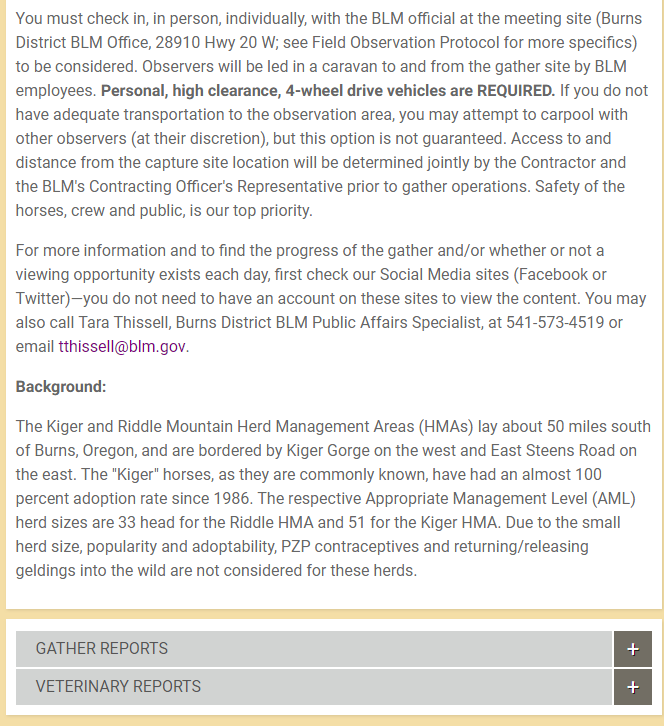
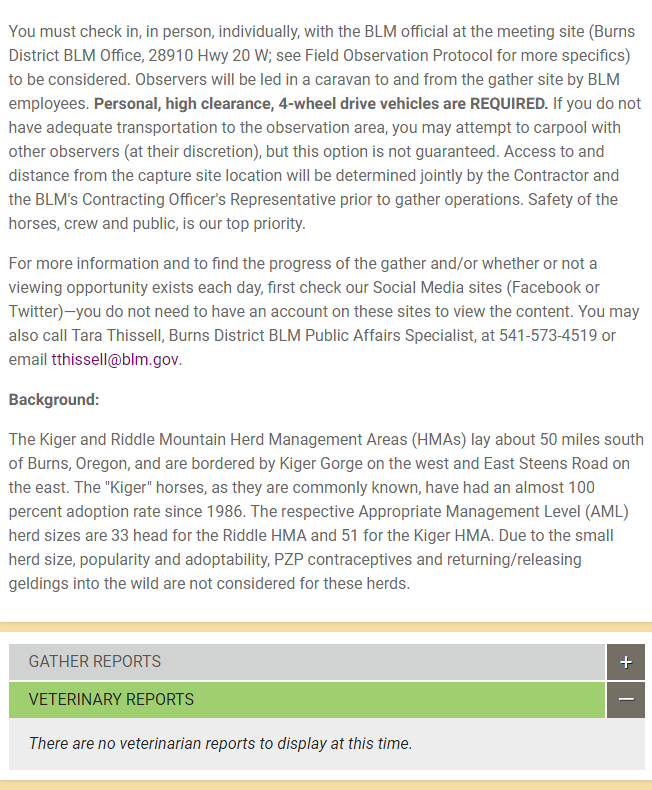
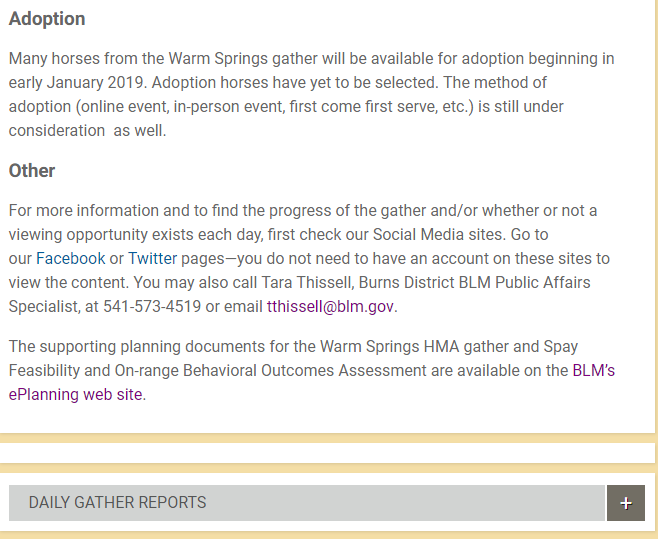
BLM reports and documentation of injury and death after and during helicopter roundups shows extreme animal cruelty as well as is inconsistent. BLM does separate web pages for each gather. Each of these pages have links to click for the Daily Gather Reports. The daily gather reports include information on how many animals are gathered, shipped, injured, and.or dead. Some webpages have a second link or tab for veterinary reports significant to that gather, while yet other pages have no tab for veterinary reports. Even pages that report deaths often have a tab for these veterinary reports, but when you click on them no reports are available.
Another recent helicopter round up was done at Warm Springs Oregon with multiple deaths also lacking information. Concurrently, CAES submitted a FOIA request for the veterinary reports on these recent deaths. Because the FOIA process takes a good length of time we do not have those reports back so I can only give my professional opinion of extreme animal cruelty based on the information provided by BLM this far.
BLM Helicopter Roundups: Extreme Animal Cruelty and Transparency Issues.
Consistency and Transparency
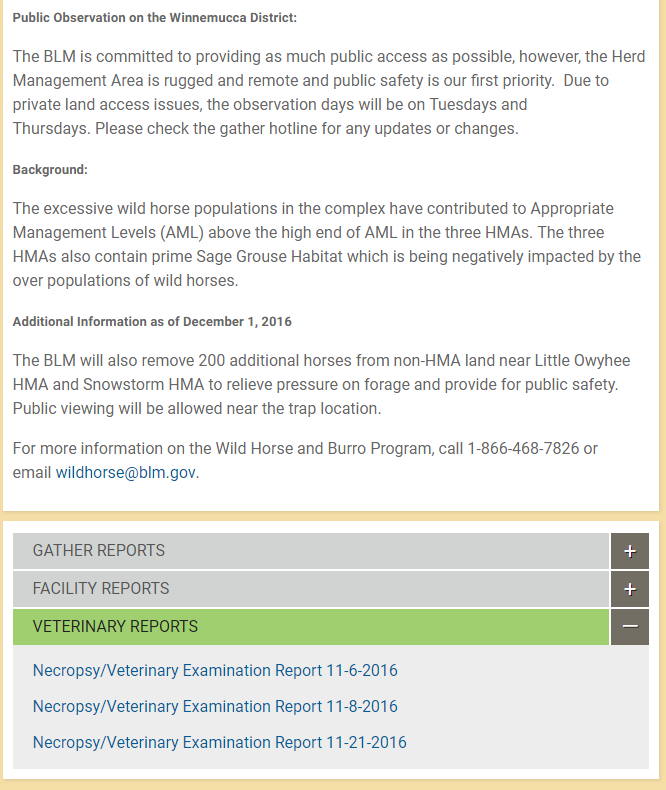
Example 1. & 2. Shows a tab to click for the Daily Gather Reports, as well as a Tab for Veterinary Reports. Even though there are deaths reported there are no veterinary reports provided.
Example 1
Example 2
Example 3 Shows the same District Office, but a different HMA wild horse gather, with a tab for Daily Gather Reports, but no tab for Veterinary Reports, even though at the time of this affidavit that ongoing gather is at a 3.8% death rate.
Example 4 Shows, from a different district office, a tab to click for the Daily Gather Reports, Facility Reports (which outline the condition of the horse upon and immediately after arrival of the horses from the gather to the holding facility), and it shows the tab for Veterinary Reports, and in this example there are 4 of them with necropsy reports.
In these 4 examples I believe it is important to note that one district office does not provide veterinary reports at all, while another provides all reports, including facility reports. So our concerns about the transparency surrounding the deaths is further supported by this inconsistent reporting.
Extreme Animal Cruelty
There are a very large proportion of what BLM calls “pre-existing conditions” mentioned in these gather reports as determined AFTER the round ups. I question many of these determinations based on the lack of medical testing to determine the injury, or the age of the injury. Without those tests BLM cannot make a determination that an injury, such as bone fracture was pre-existing, unless that horse was documented as lame before the helicopter gather began, in which case stampeding it with a helicopter over long distances and varied terrains for extended periods would be extreme, painful, animal torture and cruelty and which would only make a condition worse.
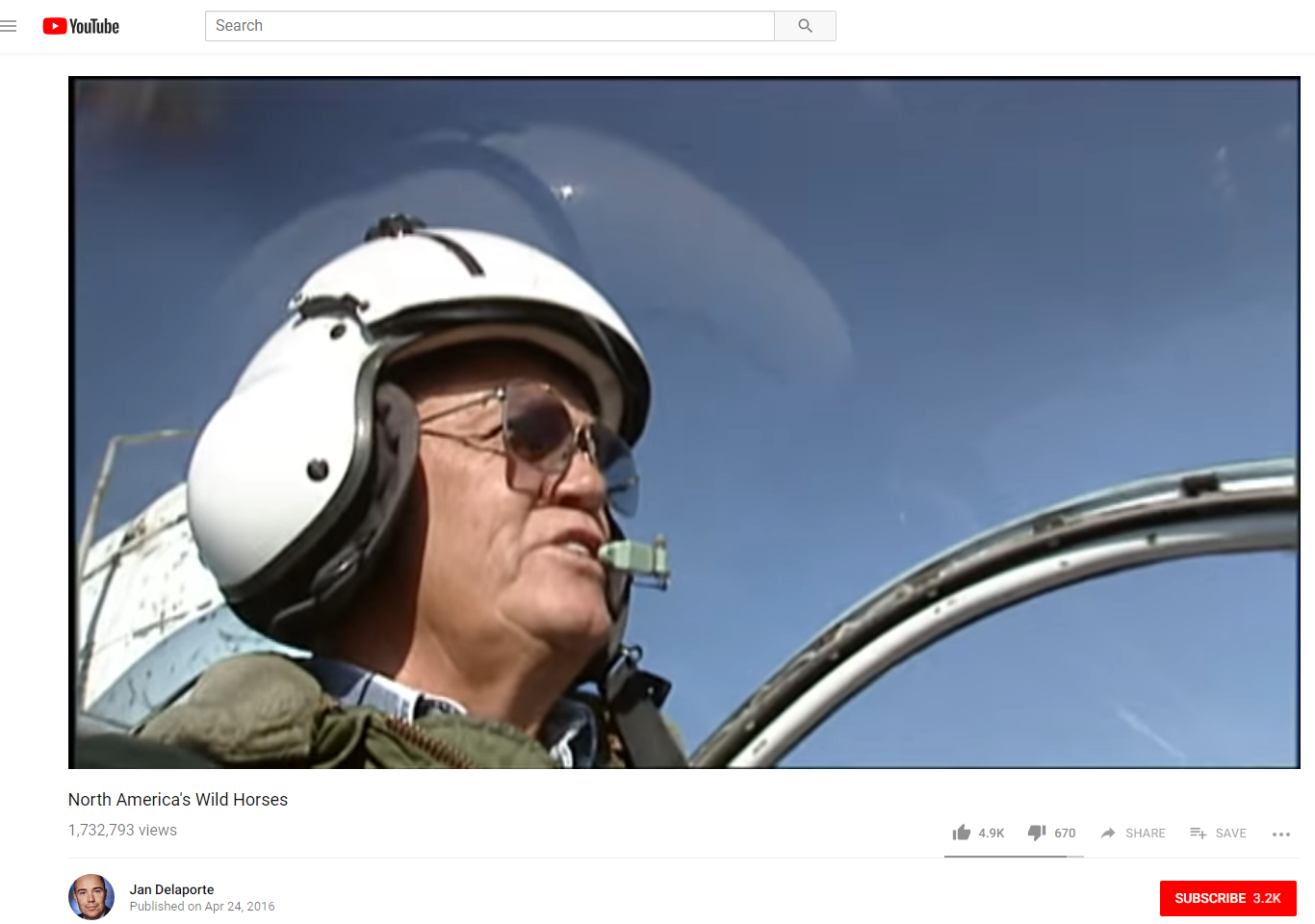
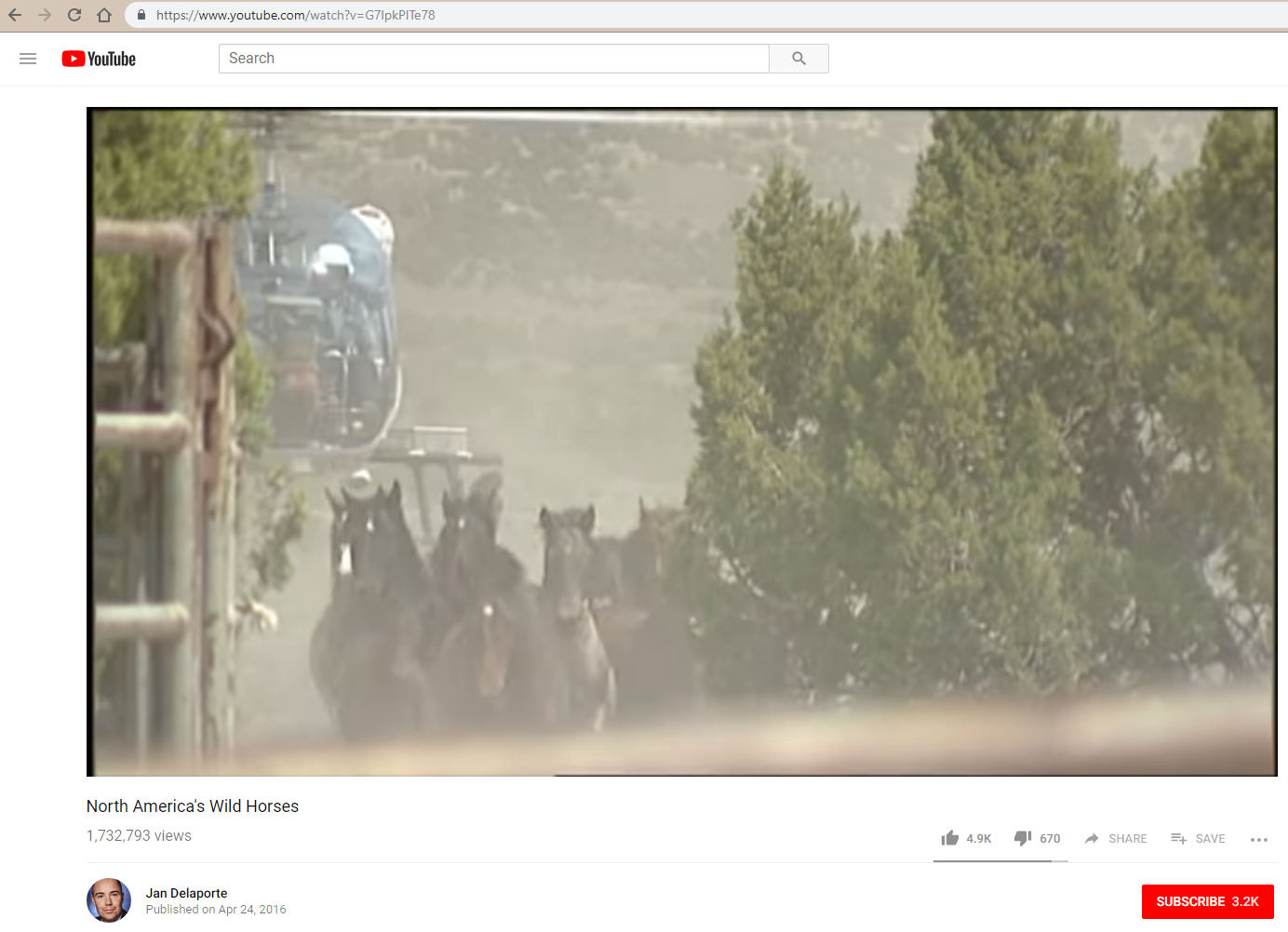
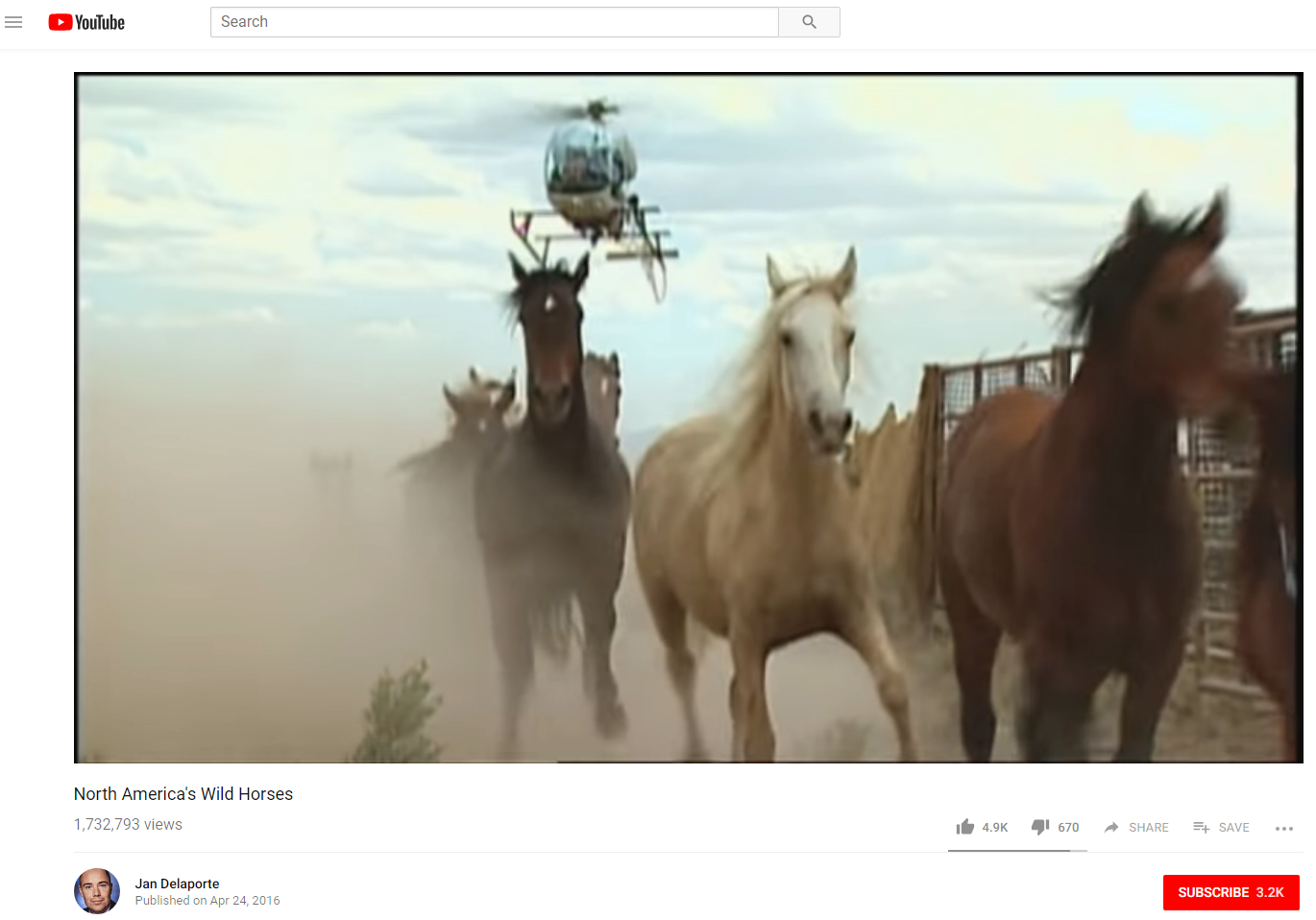
In a video “North America’s Wild Horses” BLM contractors, who perform this and many gathers, Cattoor Livestock Roundup Company used a helicopter pilot named Jim Hicks who talks about some of the difficulties he encountered during a gather such as maneuvering to get horses to come out of the trees, and the statement that concerns me most because it is still an issue 12 years after this documentary came out, is the helicopter getting very close to the horses and as this documentary said “Jim has had to get close to the ground, pushing the stallions with the helicopter skids…” The narrator explains that Hicks feels stallions are the most difficult to drive into the traps and said “They are not as easily frightened by the helicopter (as mares or foals).
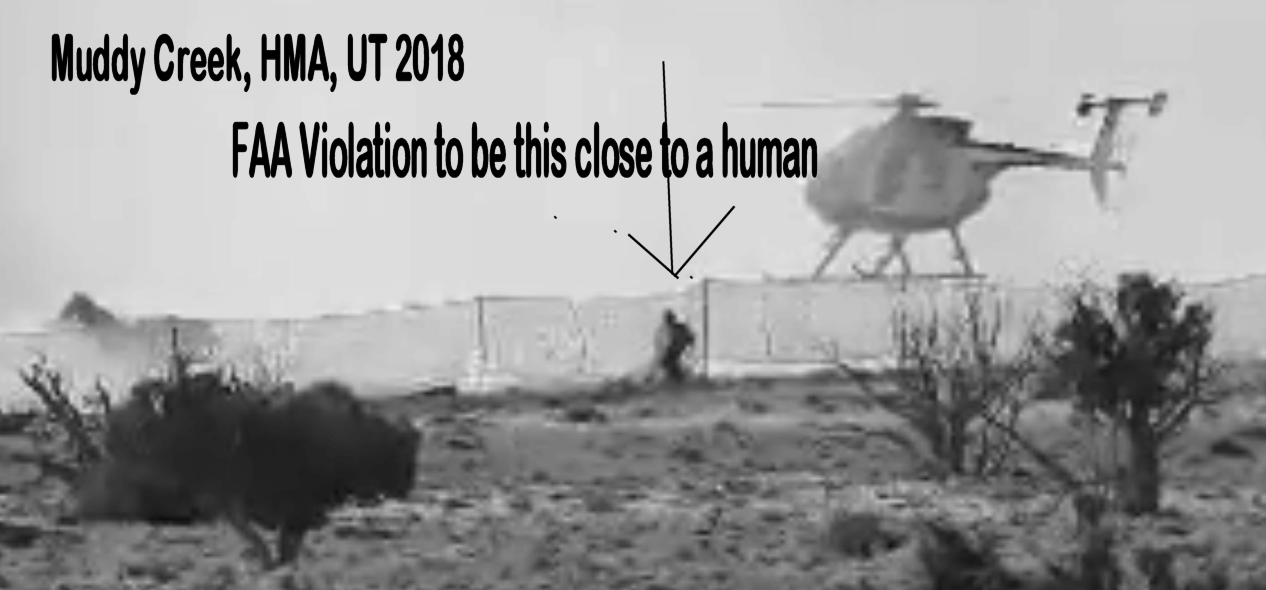
Pushing the animals with the skids, if taken literally is not allowed per law, and in this Muddy Creek gather the pilot flew so low that the pilot is seen less than 100 feet from a human, a clear FAA violation
Other conditions listed as pre-existing or chronic are simply medically impossible, some of those conditions include vaginal/rectal prolapse, colic and cervical injury resulting in loss of hind limb control. These are emergency situations where a horse would not survive for days, let alone months to be labelled a pre-existing condition. One must ask what BLM deems the length of time a horse must have had an illness or condition for it to be considered chronic/pre-existing. And if they can prove they were pre-existing again why were they inhumanely stampeded long distance over 5 – 10 minutes, with a helicopter?
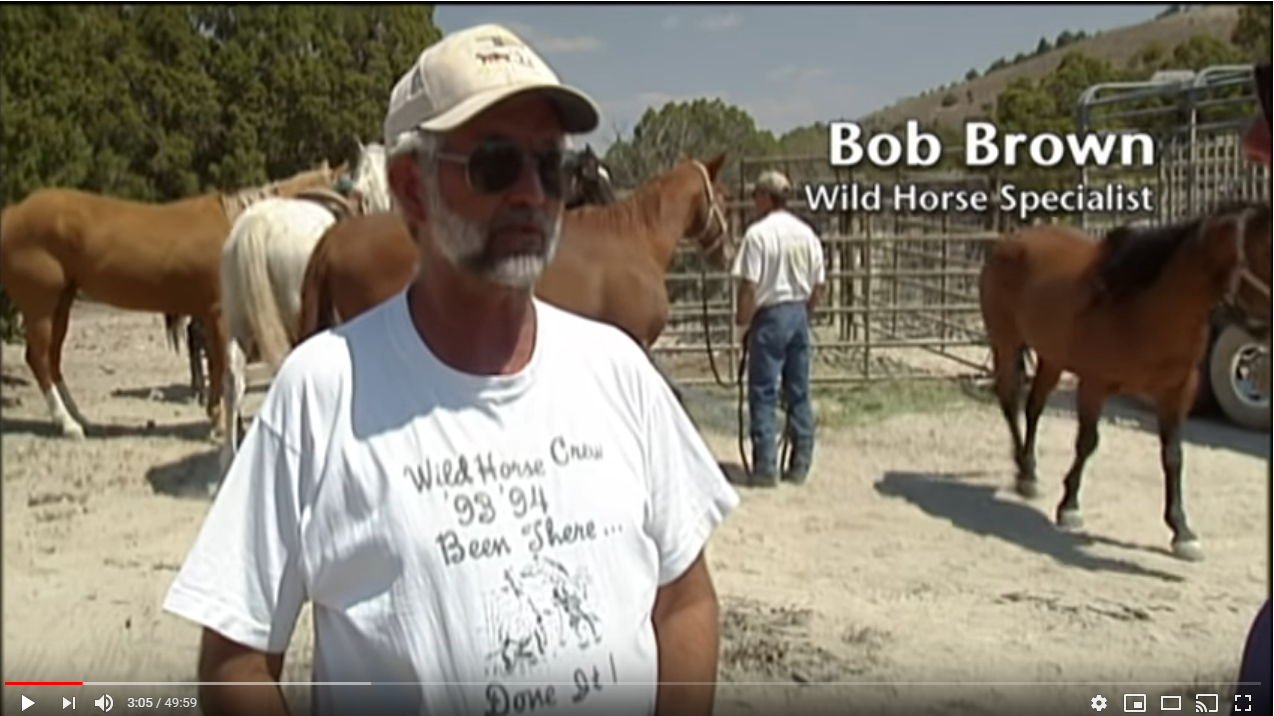
I go into some of these in greater detail below. In my professional opinion, BLM is causing many of these injuries during the stampede, trapping, and transporting and again, if not, they should not be included in a stampede round up by helicopter over differing terrain and long distances. In the 2002 documentary BLM Wild Horse & Burro Specialist Bob Brown acknowledged that the gather put stallions together that have long been competing with each other. He stated: “Some of these stallions, they absolutely hate each other and uhm, I’ve seen them where they fight coming into the wings at the end of the trap, fighting going onto the trailer. They fight in the trailer and when we turn them into the stallion pen and they fight there until they ship. They fight on the truck when we ship them to Palomino Valley.” Dr. Lennart Curt Østblom, DVM comments he’s seen that behavior too and says they are mean. Bob Brown then says “They are. They can kill a mare, they can kill a foal really easily.”
This supports my claims that BLM is knowingly breaking the animal cruelty laws both state and federally. Animal fighting and promoting it are so serious that the FBI tracks these types of individuals.
Pre-existing Conditions Listed on BLM Daily Gather Reports Resulting in Euthanasia of Wild Equines That Are Medically and Scientifically Questionable
BILATERAL RUPTURED SES(A)MOIDS Listed on the Warm Springs Wild Horse Gather, Daily Report dated 10/16/201
The first incidence is one I have only seen BLM use one time and that is “bilateral ruptured ses(a)moids”.
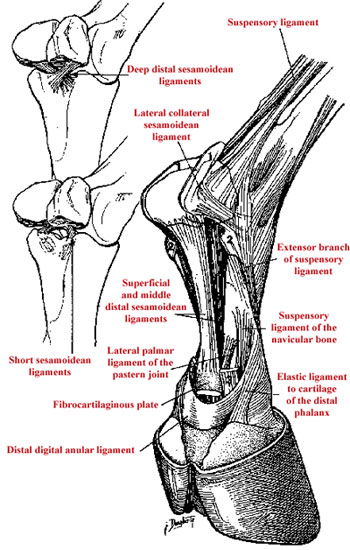
Sesamoid ruptures/fractures are an injury common in the race industry. The distal sesamoidean ligaments, suspensory ligament and sesamoid bones make up the suspensory apparatus and hold the fetlock in correct position. Injury of any of these leads to a failure of support of the fetlock joint (one of the common catastrophic injuries in the racehorse).
It is an injury caused by exposing the animal to high speeds that are unnatural to the ligamentory and skeletal load an equine is able to handle without such damage to the suspensory system.
The New York Sun explained that because “thoroughbreds are bred for flashy speed and to look good in the sales ring … the animal itself has become more fragile” This statement is in stark contrast to the well known hardiness and physical strength and stamina of a wild mustangs.
According to a study done on 269 deceased Thoroughbred racehorses (Ref. 1) results showed that sesamoid bone fractures occur more often in horses that were sexually intact males, spent more time in active training and racing, completed more events, train and race longer and have higher exercise intensities.
From BLM Warm Springs Daily Gather Report (below) you can see that this was a mare, which in a wild horse also makes it less likely for natural activity of the magnitude typical for these fractures to have occurred, unless they occurred during the stampede by helicopter.
”10/16/18: A 7 year old sorrel mare (BCS 3) captured 10/15/18 was humanely euthanized in accordance with IM 2015-070 due to pre-existing bilateral ruptured sesamoids in her hind legs, which caused severe lameness.” -BLM Warm Springs Wild Horse Gather, Daily Reports
The other note on this statement of BLM is that this was a mare with a Henneke Body Condition Score (BCS) of 3 which is below average, meaning the horse was below average weight. On the occasion that a horse that is not a racehorse suffers ligament or bone issues of the sesamoid structures it is likely to be a horse that is overweight, thus putting additional weight on the suspensory system and exacerbating the injury itself. If the horse was thin due to the injury itself and BLM claims they could visually diagnosis sesamoid rupture of the ligament then the horse would have showed lameness and it was intentional cruelty and extreme animal abuse to stampede her with a helicopter.
These injuries can be tricky to spot. Even with severe injury, the signs can be confusing. Bruising, infections and injuries to tendons can produce similar heat and swelling. A veterinarian cannot diagnosis this with a visual observation. It involves a hands-on exam, flexion tests and local nerve blocks. An ultrasound or MRI scan can help pin down the location and reveal the extent of damage to the ligament, and X-rays will show if bone is involved.
The sesamoid bones are maintained in position by the branches of the suspensory ligament proximally and by a number of sesamoidean ligaments distally. Because of the great stress placed on the fetlock during fast exercise, the abaxial portion of the proximal sesamoid bones is susceptible to stress-related injury. Sesamoiditis is a clinically distinctive condition; however, it is poorly characterized pathologically.
The clinical signs are similar to, but less severe than, those resulting from sesamoid fracture. Depending on the extent of the damage, there are varying degrees of lameness and swelling. Pain and heat are evident on palpation and flexion of the fetlock joint. Radiographic evidence of sesamoiditis involves periarticular osteophytes, entheseophytes, focal osteolysis, and enlarged vascular channels (or linear defects in the abaxial margin of the proximal sesamoid bones). Grading scales for sesamoiditis exist and particularly note the vascular channels on radiographs. Severity of sesamoiditis on radiographs has been linked to a decrease in racing performance in one study. In another study, when radiographic signs of significant sesamoiditis were present, horses had a 5 times greater risk of developing clinical signs of suspensory ligament branch injury with onset of training.
Sesamoid fractures occur (Fig 9) in the area of attachment of the suspensory ligament. Horses will present with lameness and synovial effusion. There is commonly thickening over the branch of the suspensory that attaches to the sesamoid fracture. The diagnosis is confirmed by radiography.
During early training of racehorses skeletal changes are seen. Previous studies (Reference 2) found a decrease in the mineral content of the third metacarpal bone during the first months after a young horse enters race training. As the intensity of training increased, in activity and speed required of the animals studied there were marked increases in bone mineral content as well as increased calcium, phosphorus and osteocalcin levels in the blood. “To explore the skeletal adaptations involved in early race training, bone density and morphometry were tracked in 15 Thoroughbred yearlings as they began training at a facility… During training, dorsopalmar radiographs of the third metacarpal bone were taken on a monthly basis and an aluminum step wedge was exposed simultaneously as a reference standard. Plasma concentrations of calcium, phosphorus, and osteocalcin were also measured monthly.”
These injuries would be highly unlikely to occur in wild horses unless the horse has been repeatedly stampeded at high speeds, and as shown above the diagnosis cannot be made by simply observing the horse. The diagnosis must be made with a minimum of radiographs. Other methods of diagnosis are more accurate because a sesamoid fracture is often difficult to see on a radiograph..Standing MRI scans can be used to detect a sesamoid fracture soon after it occurs.
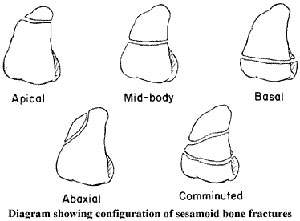
Fractures of the proximal sesamoid bones involve the apex, body or basilar portions of the bone. A radiograph in addition to showing the location of the fracture (which determines the treatment to be employed), provides additional information of value to the clinician. The extent of fragmentation and separation is an indication of the severity of soft tissue injury which may have a significant influence on prognosis. In addition to the presence or absence of new bone the appearance of the margins of the fracture is of value in estimating the interval which has elapsed since the fracture occurred. Which would determine whether the injury was in fact pre-existing or a fracturing caused by the recently completed helicopter stampede.
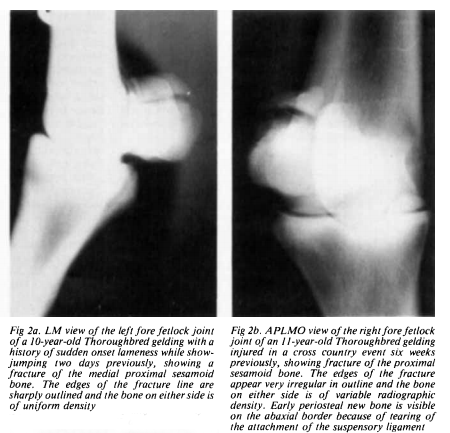
Radiographs taken soon after the trauma illustrate sharp edges of the fracture line with bone of uniform density on either side. In contrast a fracture 14 days old appears wider and its margins less easily identified (Figs 2a and b).
It has not been the standard procedure of BLM to have radiographs done, and never to my knowledge a standing MRI, on a horse exhibiting any level of lameness, therefore, I question the statement made on the BLM daily gather (death) report of a bilateral rupture of the sesamoids. And it is my opinion that absent the minimal diagnostic radiographs there is no possible authenticity to a claim that determines this as a pre-existing injury, if in fact there is a bilateral ruptured sesamoid injury. Therefore again, if this was pre-existing, this horse should not have been in a helicopter round up.
II. ANGULAR LIMB DEFORMITIES (ALD)
From one gather alone, the Warm Springs Herd Management Area (HMA) in Oregon, on one day alone (Friday, October 5, 2018) the BLM listed 11 horses as euthanized due to ALD. (Per Daily Gather Report)
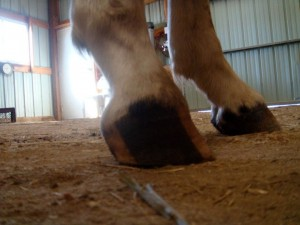
The following animals were humanely euthanized in accordance with IM 2015-070 due to angular limb deformities (ALD) in one or multiple limbs and feet. Because these angular limb deformities appear to have a genetic component and because the severity of these deformities were causing severe lameness, these animals were not suited to return to the range or placement in off-range holding or adoption. These conditions were indicated by club feet, severely overgrown hoof walls, collapsed heals, limb deformity, arthritic joints, toes pointed out at the fetlock, and lameness: A 3 year old pinto mare (BCS 3): Bi-lateral ALD A 3 year old appaloosa mare (BCS 3): Severe club foot, left front A 5 year old appaloosa stud (BCS 5): Bi-lateral ALD A 7 year old bay stud (BCS 4): Bi-lateral ALD A 2 year old bay stud (BCS 3): Bi-lateral ALD A 5 year old appaloosa stud (BCS 5): Bi-lateral ALD A 3 year old sorrel mare (BCS 3): Left front ALD and severe knee arthritis A 7 year old bay mare (BCS 5): Severe club foot, right front A 2 year old palomino mare (BCS 3): Bi-lateral ALD A 3 year old dun stud (BCS 3.5): Left front ALD An 11 year old pinto stud (BCS 4): Bi-lateral ALD
BLM states ALD is indicative of “genetics” There needs to be a complete genetic analysis done, and every horse chosen for removal should be chosen because of the genetics they would not want to continue in the herd. If this level of congenital anomaly is being seen then one must question the overall genetic health of the herd. Are they inbreeding, is this why there is this extremely high incidence of what BLM considers a “genetic component”?
ALD is common in foals for domestic horses, however there are no studies on the survivability or pain levels of an adult with ALD because it is corrected when the foal is young and abled to be molded. I question the statement that a horse with clubfoot, overgrown hoof walls, and many other foot issues,is not a good candidate for an adoption program (per BLM above statement). These are all conditions that can be, and regularly are, treated in domestic horses often with the aid of a good farrier.
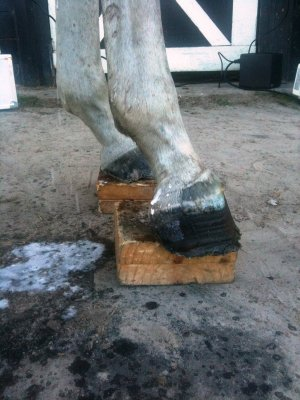
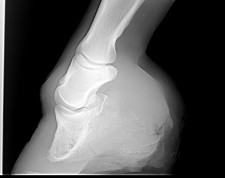
Performance Equine Veterinary Services stated the importance an exam for a proper diagnosis. “There are genetic reasons for the development of this condition of the digit joints (clubfeet) (photo below). Other factors involved are diet and exercise. Clubfoot also can be associated to pain in other region of the limb therefore is very important a complete lameness exam in order to discard a lesion elsewhere in the limb. Clinical signs of a clubfoot are a prominent bulge at the coronary band, increase in length of the heel relative to the toe, and failure of the heel to touch the ground after trimming. As the hoof growths it develops a boxy shape and a dish shape at the level of the toe.”
BLM has not done the proper tests to determine the cause of these ALD type issues to know if they are genetic or congenital. They are merely guessing. A guess is not good enough when they are the agency tasked with the health of the not only the individual horse, but also the herd as a whole, self-sustaining and thriving unit. If there are genetic problems at this level of occurrence then BLM needs to be addressing that issue, and not planning to go willy nilly into removing them to satisfy AMLs that have been proven to be arbitrary. (national Academy of Sciences, A Way Forward)
These 11 deaths and 2 additional listed as ALD, 2 additional listed as clubfoot (not ALD), 1 bilateral stifle injury (knee), and 3 additional limb fractures (from one gather) prove not only that the herd health is insignificant to BLM, but it also proves that there is NO mechanism in place to observe the herd for these lameness issues before the gather happens and as such these horses that are so lame that BLM claims the need to euthanize them, are brutally and cruelly chased at stampede speeds with a helicopter. Then after that torture they are simply shot. This is not management, it is government sanctioned, illegal and sadistic torture of animals.
III. CERVICAL/SPINAL INJURY
Is there any clinical examination of spinal cord function to make this determination? I do not believe it would be possible with wild horses as most of the tests (listed below) routinely done to diagnose spinal injury are done with hands on testing
General Examination of the Neck, Trunk, and Limbs
Slap Test
Cervicofacial Reflex
Cutaneous Trunci Reflex (“Panniculus”)
Back Reflexes
Tests for Limb Strength – hopping test, tail-pull test,
Wild and excited, anxious horses cannot be accurately examined, and even weak horses may test as normal if not relaxed, this is a problem for domestic horse diagnostics which would make it even more difficult to accurately perform testing of wild animals.
Additional to these initial hands on tests there of course are radiographs and myelography that would show these injuries, but as I mentioned above those are not tests used to determine issues of lameness, injury etc of wild horses. Absent these tests BLM is again guessing at the diagnosis, and therefore could be euthanizing a horse that could be treated with steroids or anti-inflammatory medications that would correct the what is an appearance of paralysis or lack of control caused by a cervical injury..
Again I must reiterate my feelings of how utterly irresponsible, illegal and inhumane it is to have chased one such horse with “loss of control of rear legs” with a helicopter. This loss of control of the limbs again would be something that is easily observed. The horse should have been noted before gather operations began, and should not have been cruelly chased down with a helicopter. If pre-gather observation does not happen then this is normal behavior of the BLM, and it is willful, and knowingly committing extreme animal abuse and cruelty. Obviously the BLM has the capability for observation of horses pre-gather because the same gather on the same day, BLM posts daily:
10/4/18: A 5 year roan stud (BCS 4) was humanely euthanized in accordance with IM 2015-070 due to a pre-existing cervical spinal injury that had resulted in severe lameness and lack of control of rear legs.
10/4/18: A 4 year old black stud was humanely euthanized in accordance with IM 2015-070 in the field due to a pre-existing cervical spinal injury that had resulted in severe lameness and lack of control of all legs. This stud had been observed the previous 2 days showing complete loss of body control.
One horse, the first listed was apparently gathered after being chased with loss of control of rear limbs, while the other was euthanized in the field. However, BLM doesn’t necessarily say that the field doesn’t mean at the trap site, but because “at the trap site” is terminology they use elsewhere in these gather/death reports I feel it is fair to infer that this second horse was euthanized before being gathered into the trap site.
IV. VAGINAL/RECTAL PROLAPSE
Vaginal or rectal prolapse is a dire emergency situation. It can not be called a pre-existing condition.
Uterine or rectal prolapse is not common in equines, however if happens within days, if not immediately after foaling. This diagnosis is a huge red flag that either this mare delivered her foal, or aborted it while being chased by helicopter. Recent gather’s have been video recorded of a mare being chased as she was delivering a fetus, it is unknown if she aborted or delivered a full term fetus, or if that fetus was ever located. Was this foal located? If, as BLM claims it was a tear from foaling then where is the foal that cannot be more than days old, if not just hours old when this report was made. Again…helicopter gathered are not safe and result in incidents like this where a mare that either aborted, or needed immediate medical attention if she was to care for her foal was simply ignored. A rectal or uterine (vaginal) prolapse is visible, it is an organ hanging out of the mare, and no helicopter pilot should EVER be chasing an animal such as this.
This is the post from BLM Warm Springs Daily Gather Reports on this mare:
10/4/18: A 16 year old palomino mare (BCS 2.5) was humanely euthanized in accordance with IM 2015-070 due to a pre-existing vaginal/rectal tear from foaling, resulting in a chronic partial rectal prolapse with a poor prognosis for recovery.
V. SWAYBACK
Again looking at the Warm Springs gather BLM posted this on the Daily Gather/Death Reports:
“10/8/18: A 3 year old blue roan mare (BCS 4) was humanely euthanized in accordance with IM 2015-070 due to a severe sway back condition.”
Swayback or lordosis is weakening of a horse’s supporting ligaments along the spine. Causes of lordosis include genetics, pregnancy, age, conformation, excessive strain on the back and lack of exercise.
In this case where the horse is very young, and is not domestic, therefore not subject to excessive strain of being ridden, or not subject to a lack of exercise, the cause would likely be genetic.
According to E. Bailey, of the Department of Veterinary Science, MH Gluck Equine Research Center, University of Kentucky “congenital lordosis has been reported to be associated with incomplete development of the upper thoracic vertebrae in the area of T5-T10. This causes overextension of the vertebral joints in the area and leads to this conformational problem.”
Radiographs of the area could confirm the diagnosis and would help determine that this was in fact a genetic issue. Again what is going on with the genetic health of this herd is a big question with all of the listed conditions that are more commonly congenital than not.
I do not disagree that this condition is pre-existing, but I do disagree with the necessity of euthanasia due to the condition. While horses with lordosis are more prone to back pain, many domestic horses are able to be ridden, and some even compete. I have seen some horses being ridden into their 20s with significant lordosis and without pain.
VI. COLIC
Colic is not a pre-existing medical condition it is an urgent, immediate, call the veterinarian condition, according to the Dick Vet Equine Practice Fact Sheet: Colic, the instructions listed if you believe your horse has colic are “Call your vet immediately – colic is a true veterinary emergency and time is of the essence.” And having been around horses for all these years I could not agree more with that statement.
Given the extreme urgency associated with colic in a horse, it stands to reason that the colic is a clinical sign of another issue that needed to be investigated. But it could not have been pre-existing because the horse would have been dead before it got to the holding facilities to be euthanized.
“Colic in horses is defined as abdominal pain, but it is a clinical sign rather than a diagnosis. … The most common forms of colic are gastrointestinal in nature and are most often related to colonic disturbance. There are a variety of different causes of colic, some of which can prove fatal without surgical intervention.” – Horse colic – Wikipedia
The biggest cause of colic is is a sudden abundance of fresh grasses, or inappropriate types of hay, things a wild horse may not be accustomed to that cause a sudden change for the digestive system. I believe if colic was present it was due to human error at the holding facilities or in the trap site.
VII. BLINDNESS
The Warm Springs gather reports only list one horse euthanized for being blind, which is low compared to other gathers. The horse listed in this instance was a 14 year old. The horse is also listed with a BCS of 3 which is within an acceptable range for a wild horse, who is 14 and has a disability. However, he was surviving and managing out there, and there is no need to kill him just for being blind. This happens very commonly. I do not believe that BLM should be selecting what horses survive as part of a management plan. Blindness is not painful, it is not contagious, and old horses who are blind but healthy possess much knowledge the herd depends on.
Selecting horses that are allowed to live out their lives on the range based on their ability or possible desirability (which is the case with the Kiger mustangs in 2 Herd Management Areas in Oregon) to collector/breeders is not management of wildlife. It is interfering with wildlife in an unnatural way.
Other Pre existing Conditions that are questionable but that I am not going to go into in such depth as I have above are 3 horses listed as having a pre-existing condition of a broken back, (different from those previously discussed as they are not listed as cervical which was discussed above), water deprivation or toxicity, emaciation, heavy parasite load, lip tumor, pneumonia, and several that do not even list the pre-existing condition.
The statistics on euthanasia of gathered horses in gather reports I analysed from 2015 to present show that most horses euthanized are a result of previous injuries which may have subsequently resulted in ALD and lameness, or ALD that is believed to be congenital resulting in lameness. Without proper use of diagnostic tools there is no way for BLM to determine if these were in fact pre-existing in many cases.
Inspection of the daily gather reports from BLM’s wild horse gather pages daily reports (See Reference 52) which were still online, from 2015 to 2018 we found the following results:
ConditionNumber Euthanized ALD, Lameness or Old injury 92
(included clubfoot) (29)
Unlisted Pre-existing Condition 28 Blindness 25
Age Related (Tooth, Arthritis, Low BCS etc.) 19
Body Condition Score (BCS)
Non Age Related low BCS 13
Illnesses (Colic, Pneumonia, lip tumor) 7
Water Deprivation or Toxicity 3
The Horses that BLM admitted were euthanized due to the gather from injuries (mostly broken necks) were 37. And 3 foals that were orphaned.
A horse so frantic that it runs into panels and breaks its neck is a terrified horse. This is unacceptable and it cannot be categorized as management, but rather planned, intentional murder.
Helicopter gathers have proven to have much higher death rates than BLM has stated to the public, many times in many places, for example Rob Sharpe, the Wild Horse and Burro Specialist for Burns District Office BLM in Oregon, stated that the death rate from helicopter gathers was less than 1%. As of October 26, 2018 (the gather has not yet been listed as completed) the gather of the Warm Springs herd, of which he is overseeing has a death toll of 3.8% or nearly 4 times what he told the public.
Summary
In summary helicopter roundups are extreme animal cruelty, running wild horses in a stampede with previous injuries and also causing serious injuries during and after this unnatural ordeal.
These issues are specifically hidden by the BLM (Red Rock Utah Gathers) in an arbitrary and capricious manner. The BLM is only as transparent as they choose on a case by case basis.
Moreover, Helicopter round-ups are fraudulent. The BLM is hiding the facts that:
1. Wild horses do not need to be rounded up first,
2. Wild horses do not need to be transported to holding for darting
3. Wild horses do not need to be branded for darting
4. Wild horses do not need to be transported back for release.
This is because with PZP (Zona stat H) as registered by the EPA as a non-experimental vaccine, no further data is required per the registration.
Therefore:
Wild horses can be darted without being branded, on the range, with no holding, no handling by helicopter (over 100 meters high), by lure trap, or on foot.
Hence, the BLM falsely inflates the cost of PZP darting by including the cost of round ups, transport, feeding, holding, branding, foot trimming etc However they are not transparent and instead they SAY that it is not practical because the contraceptive has to be darted yearly or every two years. Evenso, this is feasible y comparison. (See Attachment I)
BLM is choosing to hide that these horses could be feasibly darted on the range by helicopter, or by lure trap. This is again on a case by case basis in an arbitrary and capricious manner. Here at Muddy Creek, there is no valid cost analysis. showing that simple on range darting by helicopter in this wide open HMA could keep the population below the higher AML while BLM’s extreme bias against these sentient beings that is at issue as shown unnecessary they are unnecessary, they are fraudulent based on fraudulent cost analysis versus using PZP without round ups, handling, and holding, and can be darted on the range and since 2012 when the EPA registered Zona Stat H (PZP) for use on wild horses as a contraceptive versus
References
Risk factors for proximal sesamoid bone fractures associated with exercise history and horseshoe characteristics in Thoroughbred racehorses; Lucy A. Anthenill, DVM; Susan M. Stover, DVM, PhD; Ian A. Gardner, BVSc, PhD; Ashley E. Hill, DVM, PhD
Skeletal Adaptations With The Onset Of Training Thoroughbreds January 1, 2007; Pagan, J. D., L. A. Lawrence and D. Nash. 2007. Skeletal adaptations with the onset of training Thoroughbreds. In: Proc. 20th Equine Science Society. Hunt Valley, Md. June 5 – 8. pp. 148 – 149.
Traumatic Joint Disease; C. Wayne McIlwraith BVSc, PhD, FRCVS, Diplomate ACVS Professor and Director, Orthopaedic Research Center, Colorado State University
Axial osteitis of the proximal sesamoid bones and desmitis of the intersesamoidean ligament in the hindlimb of Friesian horses: review of 12 cases (2002-2012) and post-mortem analysis of the bone-ligament interface. Brommer H, Voermans M, Veraa S, et al.; BMC Vet Res. 2014;10:272. Published 2014 Nov 19. doi:10.1186/s12917-014-0272-x
Interpreting radiographs 2 : The fetlock joint and pastern; G. B. Edwards; Department of Surgery and Obstetrics, Royal Veterinary College, Hawkshead House, Hawkshead Lane, North Mymms, Hatfield, Hertfordshire; Equine Veterinary Journal; Equine vet. J. (1984) 16 (l), 4-10
Equine Sports Medicine and Surgery (Second Edition) 2014, Pages 275-296; Distal limb: Fetlock and pastern; Alicia L.Bertone
An Unknown Filly Dies, and the Crowd Just Shrugs; William C. Rhoden, The New York Times 25 May 2006.
Diseases of joints, tendons, ligaments and related structures: Adams’ Lameness in Horses, ed 4.; Stashak TS:; Philadelphia, Lea & Febiger, 1987, pp 582–583.
Clinical relevance of radiographic findings in proximal sesamoid bones of two-year-old standardbreds in their first year of race training; Hardy J, Marcoux M, Breton L: JAVMA 198:2089–2094, 1991.
Clinical relevance of the microvasculature of the equine proximal sesamoid bone; Trumble TN, Arnoczky SP, Stick JA, et al:; Am J Vet Res 56:720–724, 1995.
Quantitative evaluation of the remodeling response of the proximal sesamoid bones to training-related stimuli in thoroughbreds; Young DR, Nunamaker DM, Markel MD: Am J Vet Res 52:1350–1356, 1991.
Fractures of the proximal phalangeal sesamoid bones; Wirstad HF: Vet Rec 75:509–513, 1963.
Apical fractures of the proximal sesamoid bones in 109 standardbred horses; Spurlock GH, Gabel AA: JAVMA 183: 76–79, 1983.
Management of proximal sesamoid bone fractures in the horse; Fretz PB, Barber SM, Bailey JV, et al: JAVMA 185:282–284, 1984.
Injuries of the proximal sesamoid bones, in White NA, Moore JN (eds): Current Techniques in Equine Surgery and Lameness, ed 2. Ruggles AJ, Gabel AA: Philadelphia, WB Saunders Co, 1998, pp 403–408.
Suspensory ligament desmitis. Dyson SJ, Arthur RM, Palmer SE, et al:Vet Clin North Am Equine Pract 11:177–215, 1995.
Arthroscopic removal of apical and abaxial sesamoid fracture fragments in five horses. Palmer SE: Vet Surg 18:347– 352, 1989.
Use of electrocautery probes in arthroscopic removal of apical sesamoid fracture fragments in 18 standardbred horses. Boure L, Marcoux M, Laverty S, et al: Vet Surg 28:226–232, 1999.
Apical fracture of the proximal sesamoid bone in standardbred horses: 43 cases (1990–1996). Woodie JB, Ruggles AJ, Bertone AL, et al: JAVMA 214:1653–1656, 1999.
Lag screw and cancellous bone graft fixation of transverse proximal sesamoid bone fractures in horses: 25 cases (1983–1989). Henninger RW, Bramlage LR, Schneider RK, et al: JAVMA 199:606–612, 1991.
Circumferential wiring of mid-body and large basilar fractures of the proximal sesamoid bone in 15 horses. Martin Jr BB, Nunamaker DM, Evans LH, et al: Vet Surg 20:9–14, 1991.
An in vitro biomechanical comparison of two fixation methods for transverse osteotomies of the medial proximal forelimb sesamoid bones in horses. Wilson DA, Keegan KG, Carson WL: Vet Surg 28:355–367, 1999.
Surgery of the fetlock joint. Copelan RW, Bramlage LR: Vet Clin North Am Large Anim Pract 5:221–231, 1983.
Nongrafted and grafted osteotomies of the proximal sesamoid bones of the horse. Medina LF, Morgan JP: Vet Radiol 25:78–85, 1984.
In vitro biomechanical properties of two compression fixation methods for midbody proximal sesamoid bone fractures in horses. Woodie JB, Ruggles AJ, Litsky AS: Vet Surg 29: 358–363, 2000.
Basal sesamoidean Compendium July 2001 Equine 685 Figure 6—Dorsoplantar radiographic projection of a sagittal (axial) proximal sesamoid bone fracture (arrows) with an associated lateral condylar fracture. fractures in horses: 57 cases (1980–1991). Parente EJ, Richardson DW, Spencer P: JAVMA 202: 1293–1297, 1993.
Special radiographic projections for the equine proximal sesamoid bones and the caudoproximal extremity of the first phalanx. Dik KJ: Equine Vet J 17:244–247, 1985.
Stress protection afforded by a cast on plate fixation of the distal forelimb in the horse in vitro. Parente EJ, Nunamaker DM: Vet Surg 24:49–54, 1995.
Arthroscopic removal of abaxial fracture fragments of the proximal sesamoid bones in horses: 47 cases (1989–1997). Southwood LL, Trotter GW, McIlwraith CW: JAVMA 213:1016–1021, 1998.
Arthroscopic removal of fracture fragments involving a portion of the base of the proximal sesamoid bone in horses: 26 cases (1984–1997). Southwood LL, McIlwraith CW: JAVMA 217:236–240, 2000.
Fractures of the proximal sesamoid bones in thoroughbred foals. Ellis DR: Equine Vet J 11:48–52, 1979.
Axial sesamoid injuries associated with lateral condylar fractures in horses. Barclay WP, Foerner JJ, Phillips TN: JAVMA 186:278–279, 1985.
Causes of death in racehorses over a 2-year period. Johnson BJ, Stover SM, Daft BM, et al: Equine Vet J 26:327–330, 1994.
Fractures of the proximal sesamoid bones, in Nixon (ed): Equine Fracture Repair. Bertone AL: Philadelphia, WB Saunders Co, 1996, pp 163–171.
Functional anatomy of equine locomotor organs, in Stashak TS (ed): Adams’ Lameness in Horses. Kainer RA: Philadelphia, Lea & Febiger, 1987, pp 10–18.
Proximal sesamoid bone fractures in horses: Current treatments and prognoses. Bukowieki CF, Bramlage LR, Gabel AA: Compend Contin Educ Pract Vet 7:S684–S698, 1985.
Incidence and location of fractures of the proximal sesamoids and proximal extremity of the first phalanx. Schneider RK: Proc AAEP 25:157–158, 1979.
In vitro strength of the suspensory apparatus in training and resting horses. Bukowiecki CF, Bramlage LR, Gabel AA: Vet Surg 16:126–130, 1987.
Sesamoiditis in the thoroughbred: A radiographic study. O’Brien TR, Morgan JD, Wheat JD, et al: J Am Vet Radiol Soc 12:75–87, 1971.
Entheses and enthesopathy: Anatomical, pathological, and radiological correlation. Radiology 146:1–9, 1983.; Resnick D, Niwayama G
Radiographic and histological assessment of proximal sesamoid bone changes in young and working horses. Poulos PW: Proc AAEP 34:347–358, 1988.
Rectal Prolapse; By Stanley I. Rubin, DVM, MS, DACVIM, Clinical Professor, Department of Veterinary Clinical Medicine, College of Veterinary Medicine, University of Illinois at Urbana-Champaign
Uterine Prolapse in a Mare; F. R. Chisholm; La revue veterinaire canadienne vol. 22,8 (1981): 267.
Swayback in a Young Horse; Ed Boldt, Jr., DVM | Mar 16, 2016 | Article, Back and Spine, Conditioning Young Horses, Horse Care, Musculoskeletal System, Sports Medicine
Genetics of swayback in American Saddlebred horses; D. Cook, P. C. Gallagher and E. Bailey Department of Veterinary Science, MH Gluck Equine Research Center, University of Kentucky, Lexington, KY 40546-0099, USA
The cream dilution gene, responsible for palomino and buckskin coat colours, maps to horse chromosome 21. Animal Genetics 32, 340–3.; Locke M.M., Ruth L.S., MIllon L.V., Penedo M.C.T., Murray J.D. & Bowling A.T. (2001)
Identification of candidate regions for familial idiopathic scoliosis. Spine 30, 1181–7; Miller N.H., Justice C.M., Marosy B., Doheny K.F., Pugh E., Zhang J., Dietz H.C. 3rd & Wilson A.F. (2005)
PLINK: a toolset for whole-genome association and population-based linkage analysis; Purcell S., Neale B., Todd-Brown K. et al. (2007); American Journal of Human Genetics. 81, 559–75.
Congenital equine scoliosis and lordosis. Clinical Orthapaedics and Related Research 62, 25–30; Rooney J.R. (1969)
Congenital lordosis of the horse; Rooney J.R. & Pickett M.E. (1967); The Cornell Veterinarian 57, 417–28.
Equine Pathology; Rooney J.R. & Robertson J. (1996) Iowa State University Press, Ames. p. 222.
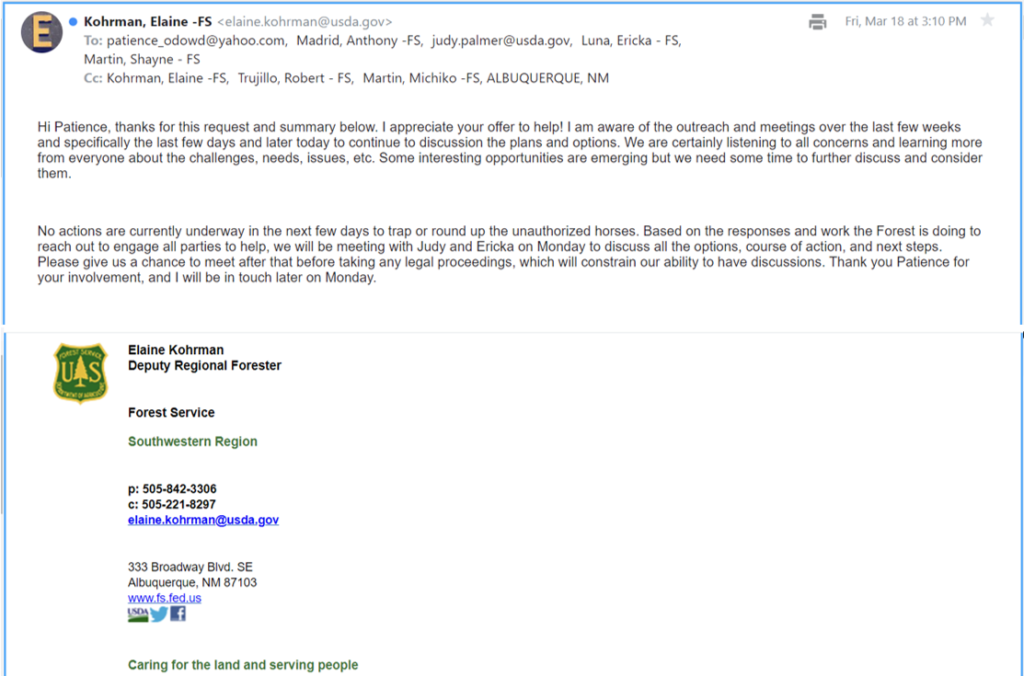
Will hear back from Forest Service again later today (3/21/2022)
Forest Service Response below: (emphasis added)
From: Patience O <patience_odowd@yahoo.com> Sent: Friday, March 18, 2022 1:43 PM To: Madrid, Anthony -FS <anthony.madrid@usda.gov>; judy.palmer@usda.gov; Luna, Ericka – FS <ericka.luna@usda.gov>; Kohrman, Elaine -FS <elaine.kohrman@usda.gov>
Re: HALT/STAY the plans to round up the Apache National Forest and include WHOA in the meeting today via phone. (updated)
Elaine KohrmanDeputy Regional ForesterUnited States Department of AgricultureForest ServiceSouthwestern Region333 Broadway Blvd. S.E.,Albuquerque, NM 87102
Re: Open request for STAY of this “Police Action of Impoundment” of the Apache National Forest Wild Horses as advertised quietly in a local paper on Dec 21st, 2021 .
3/18/2022
Dear Forest Service Professionals,
With all due respect, I am contacting you to let you know that this round up of Wild Horses has not been legally justified and must in fact go through a thorough and Holistic NEPA process.
I have spoken in some detail with Anthony, Ericka, and Judy day before yesterday in good faith.
I havegiven them good cause to delay/stay/halt these round-up plans. Very likely you have each taken notes and recorded as did I.
If you would like the recordings I will openly share them with you. We are all public servants though I myself am not paid intentionally. Hence, we should all be on the same team.
WHOA, WHOA-Voters board members, and CAES do have standing in the issues of the Apache Forest Horses and this does not only stem from our previously established standing in the public process and affidavits regarding the Apache Sitgreaves horses.
There has been so little advance notice in this ill-advised project that I am writing this to attempt to save you and the tax payers time in court and also in the hopes of a true positive.
Please schedule a meeting with WHOA and please STAY this project. WHOA is a long term team member with the USDA FS and we have a 22 year history together. We have always been able to manage to sort things out. Our goal is not to find new “homes” for these horses.
We have a holistic win win goal for the tax payer, the environment, green jobs for public lands ranchers, the trophic cascade, and the USDA FS. We are willing and able to be a functional part of this on and off the ground.
I am personally asking you to STAY this project and to understand that WHOA and the public will work with you including making an actual count of these horses as well as a sucessful management plan for these horses/families at no charge.
My only request is that the USDA FS not pay people with a known history of anti-wild horse to “work” on the project at the outset.
Note: There has also been no proof of horses with halters or brands provided to the public. There has been no proof given to myself, (though I have asked), WHOA, WHOA-Voters, to the public, or listed in the Federal Register pursuant to the U.S. District Court District of Arizona )Tucson Division) Civil Docket #4:20-cv-00525-LCK that shows or tends to show, that these wild horses have had any negative impact on any endangered specie listed.
There is no proof that these horses themselves not native and WHOA has evidence on the contrary. This issue is well known to be very controversial with the overwheming majority of Americans pro-wild horse and even more so those without a conflict of interest.
Mismanagement of this issue has also had a very damaging culmulative impact across a number of areas including: climate change, the 6th mass extinction, chronic wasting disease, hunting, public lands ranching, ski resorts, public health, horse rescues, horse business’, invasive species, tax payers, watersheds, water, firesheds, and more.
Instead, let us forge a new and different path and win together for all of us including biologic diversity itself, as we really must, and right away, according to the IPCC Report for Policy Makers taking into account, jobs, the 6th mass extinction, and humane requirements on morality as well as our future here together.
We/I will deeply regret if the USDA FS goes down this path in this manner thereby requiring lawyer involvement.
As always, I personally look forward to working together. Lets get together asap.
With ALL due Respect,
Patience O’Dowd
Wild Horse Observers Association. a 501 c3 non-profit corp. since 2004
Wildlife Protection of NM WHOA-Votersa 501 c4 non-profit corporation
Citizens Against Equine Slaughtera 501 c3 non-profit corporation
PO Box 932 Placitas, NM 87043
whoanm.org 505-610-7644
—– Forwarded Message —–From: Linda Kemp >To: Patience O <patience_odowd@yahoo.com>Sent: Friday, March 18, 2022, 12:30:33 PM MDT
Subject: Forest Service contact
HI,The following people were contacted so I could be included in the meeting with the advocates on March 17,2022. I left 2 voice messages with no response to: Supervisor’s Office P.O. Box 640 30 S. Chiricahua Dr. Springerville, AZ 85938 928-333-6280 Fax:928-333-5966
Fron Salt river post used their number”And we are calling for the humane treatment of this historic wild horse population by the Forest Service, this is the correct number: (928) 235-5764.” I also contacted Samone Netherlands from the Salt River advocates early March 18 for a link for the meeting and was told there is no room for WHOA in the meeting. The texts forwarded on the conversations. Linda Greaves contacted Jeff from the Alpine Forest Service and was told that AHOA should attend the meeting. The Alpine Forest service, PR for the Forest service, Jeff, and the Salt River team knew nothing about President’s Biden’s plan for wildfire abatement plans in the hot zones where native wild horses are moving thru. Thank You Linda Kemp
This section of NM RT165 is an important wildlife corridor of the Sandia Mountain section of the Rocky Mountains.
The wild horse died instantly and no humans were harmed.
Resident of Placitas charged with (1) Reckless Driving, (2) Animal Cruelty, (3)Leaving the Scene of an accident, (4)Making a False Affidavit, (5)Making a False Report of a Violation of the Criminal Code
VIDEO – December 3rd 2021, at 7:30 AM. Video of a driver going possibly 90mph in a 35mph zone per Officer’s Report – CAES NO. 21-001727 – Video above obtained from a passerby’s dash-cam and provided to police by Gary Miles of Placitas. Gary Miles also picked up the body.
Officer’s Narrative excerpts:
“Samuel’s speed at the time he hit the horse was likely double the speed limit possibly as high as 90mph in a 35mph zone from my speed estimates from the video and the time and distances traveled.” . . .
“Given this behavior Samuel could have easily hit oncoming traffic containing children on their way to school. With this in mind Samuel was driving in a reckless and negligent manner and will be charged with Reckless Driving.
Due to the, “Negligent Killing without Lawful Cause”, of the horse that resulted from his Reckless Driving. Samuel will also be charged with, “Misdemeanor Cruelty to Animals”.
“. . . Samuels vehicle was drivinging the exact center of the eastbound lane while driving westbound. . . . The photographs clearly showed that Samuel turned onto Interstate 25 drove down interstate 25 then got off at the 240 exit in Bernalillo.”
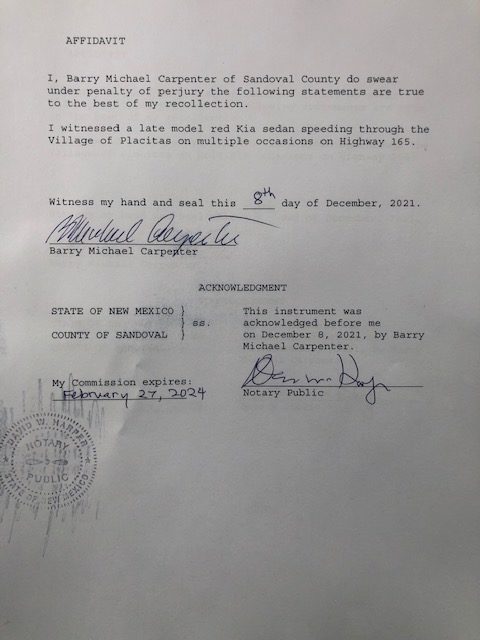
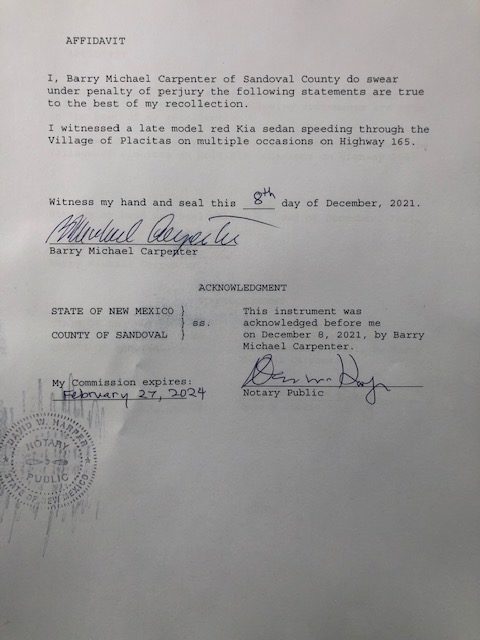
There are 5 witness in this case. There is also another Placitan and affidavit stating that this car has been seen through time speeding through the village from Casa Rosa on Friday and Saturday mornings through time. Affidavits below.
The video above, affidavits, and other witness’ clearly show:
This stretch of highway NM 165 is an official Wildlife Corridor in the rural mountain community of Placitas, NM.
The young wild stallion was hit in the rear, breaking both back legs and he apparently died instantly. There were no gorey acts of “mercy” attempted or required after impact.
The wild horse was hit by the Red Kia and sent flying forward approximately120 feet, landing off the South Side of the road and did not land on the road.
The car was clearly speeding recklessly through the village in the early morning.
The car was driven from the scene to Bernalillo, not left at the scene, and not stolen from the scene.
There are 5 witness in this case. There is also another Placitan and affidavit stating that this car has been seen through time speeding through the village from Casa Rosa on Friday and Saturday mornings through time and this Affidavit is also posted above.
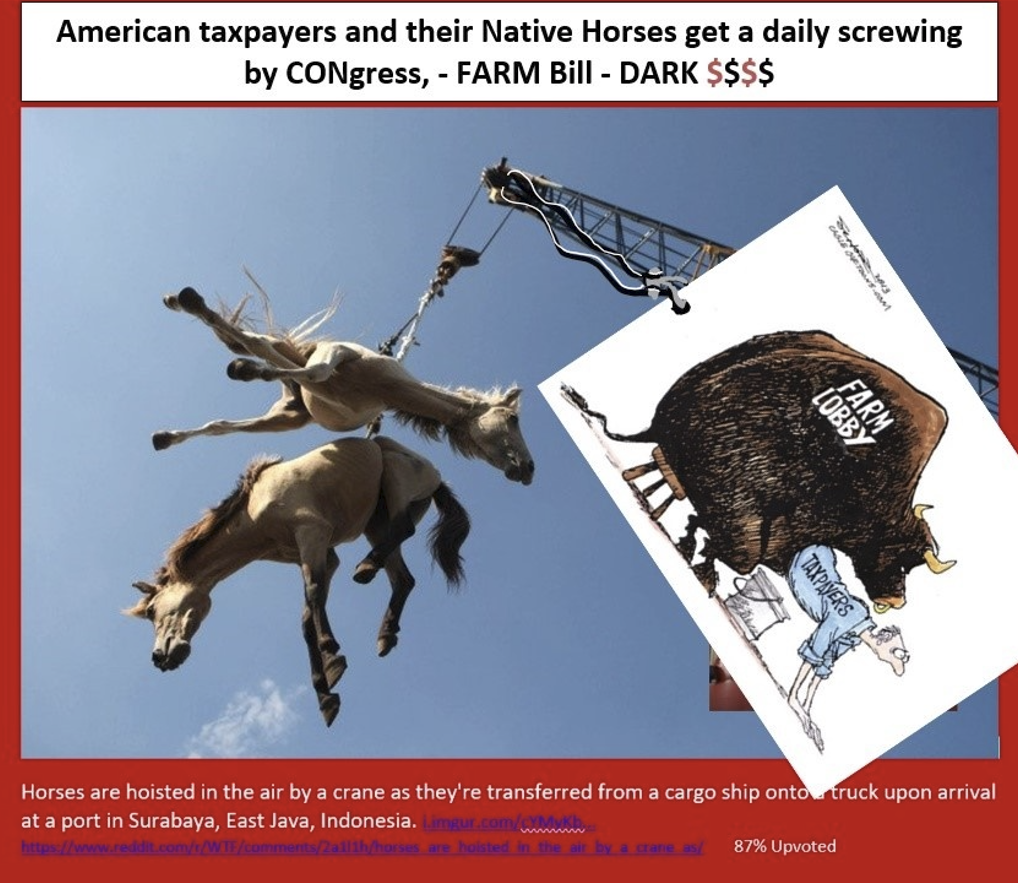
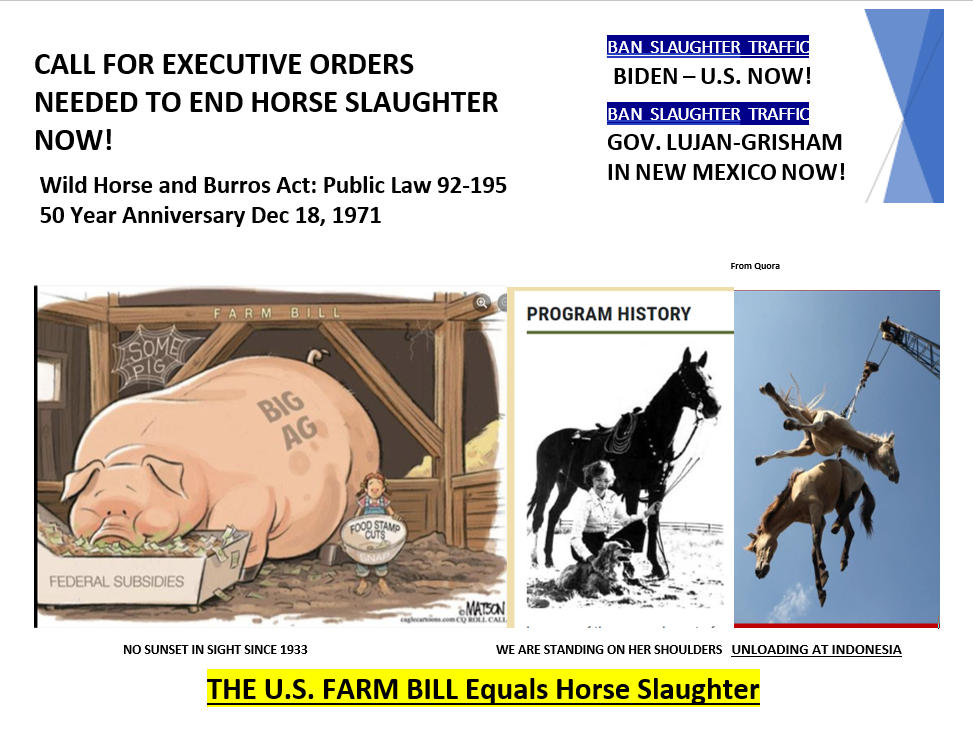
Canadian Prime Minister Trudeau[1] has made a call[2] to “Ban the live export of horses for slaughter”. President Biden also has an opportunity to do so likewise, by signing an executive order to immediately ban an inhumane[3] practice which has been incentivized by bi-partisan Farm Bill corruption[4] and conflicts of interest[5], all in support of the livestock industry. Horses are flight animals and not biologically livestock.
By Patience O’Dowd et al.Endorsed byDr. Lester Friedlander DVM
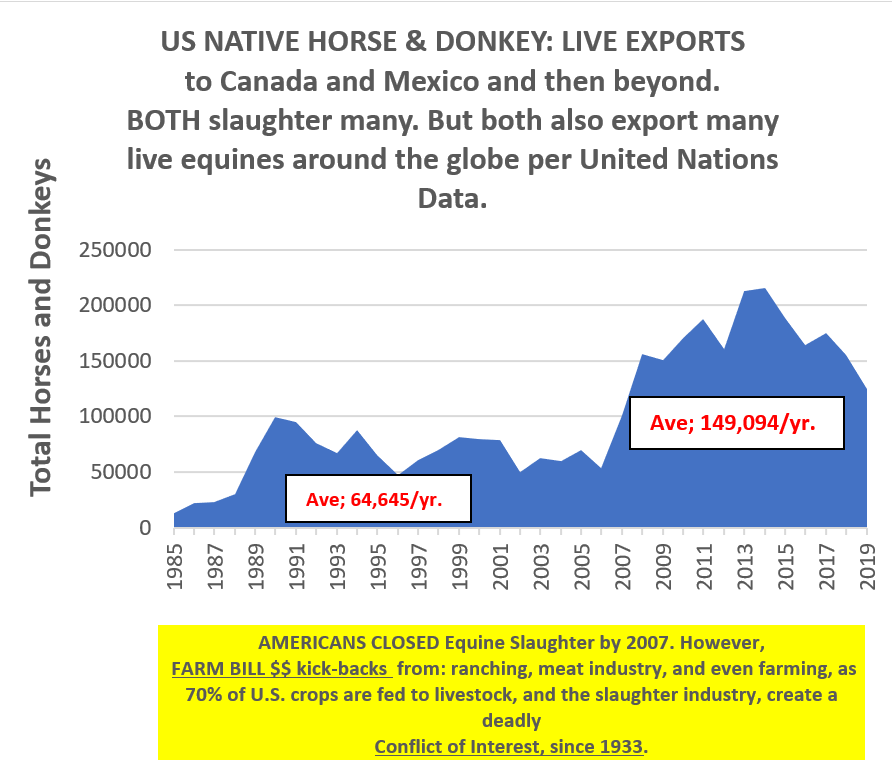
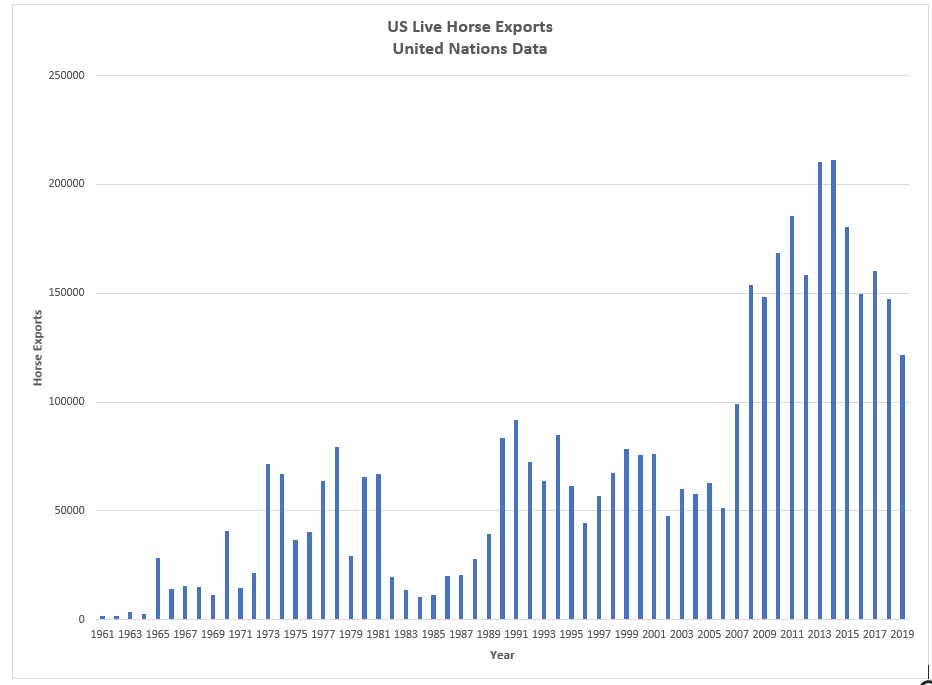
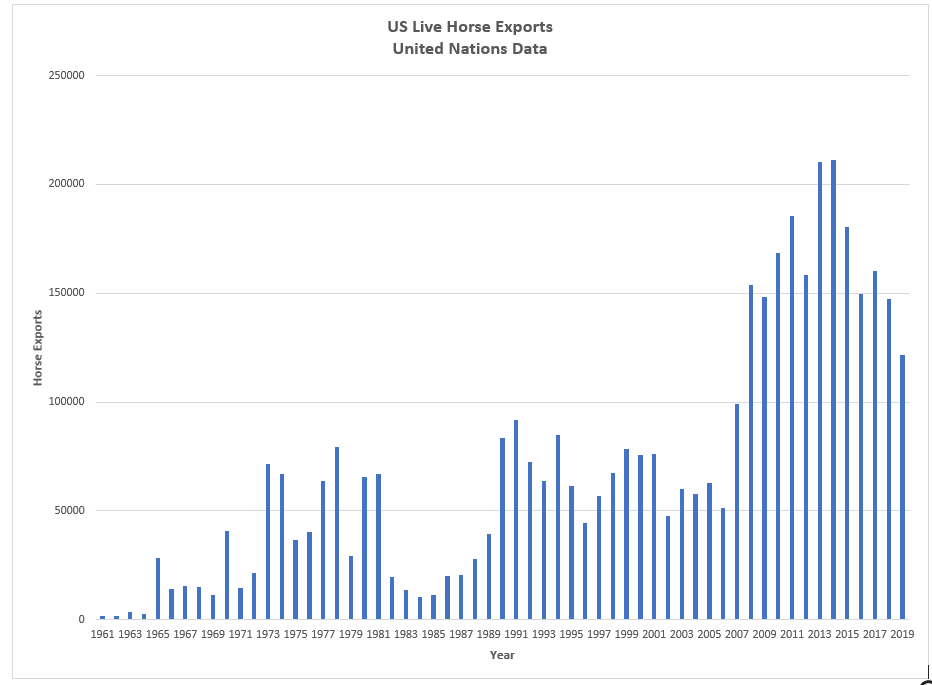
We, the 80% of Americans who are strongly opposed to equine slaughter, had a huge victory when Americans[6] shut down[7]all horse[8]-slaughter-plants on U.S. soil before 2007. It was crystal clear that Americans wanted this ban. However, behind our backs and over our borders, every U.S. President[9] and every Congress since 2007 have more than DOUBLED HORSE SLAUGHTER and LIVE INTERNATIONAL TRANSPORT around the globe through both Mexico and Canada, per United Nations data.
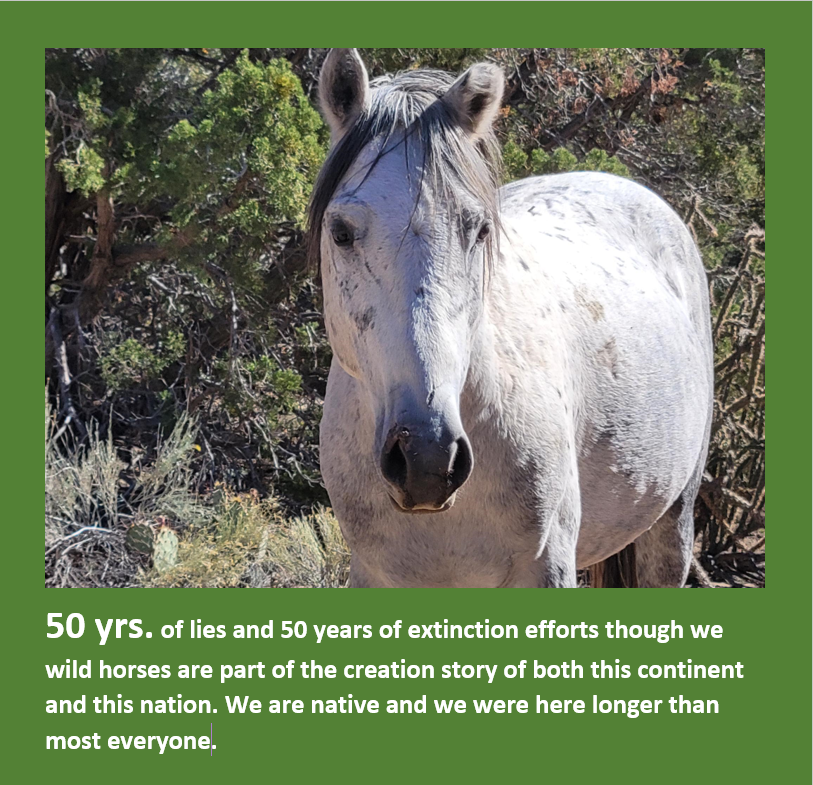
Note: All equines are native to North America.
The annual funding of the Farm Bill drives the export and slaughter of our horses, which are a native mega-fauna of the Americas. The livestock industry, which is a gigantic beneficiary of subsidies (both direct and indirect) of the Farm Bill, view the horses as competitors for resources which they seek to eliminate. Moreover, 67[10] to 70% of “Farm” crops in the U.S. are fed to livestock.
“The Washington-based Center for Public Integrity, a group of investigative journalists, lists 1,506 companies in agriculture who hired lobbyists from 1998 to 2004, with 552 in 2004 alone.”
“Because the largest agribusinesses are the chief beneficiaries of agriculture policy, they have both the incentives and resources necessary to invest heavily in maintaining the current flow of subsidy dollars. Through representative organizations, they have served on federal commissions, testified before Congress, and donate millions of dollars to federal political candidates. Not surprisingly, the House and Senate farm bills include many of the provisions that these groups support, including massive farm subsidies and price supports.3 “
“Almost two-thirds of America’s farmers receive no subsidies at all, but those who do are passengers on the mother of all gravy trains.”
“Working through their lobbyists and often directly with congressional staffers, the farm groups also contribute generously to campaign coffers, as noted.”
This is a self-perpetuating process which allows “farm groups” to obtain your tax dollars to influence your legislators.
We are calling on President Biden to END EXPORT OF AMERICAN HORSES FOR SLAUGHTER NOW by Presidential Executive Order[12]. All U.S. presidents in office for more than a month have used Executive Orders when it suited them: Bush 291, Obama 276, Trump 220, Biden at 96 so far!
“With an Executive Order[13], Presidents can change course without the approval of Congress. From the internment of Japanese Americans during World War II to President Harry Truman’s order to abolish segregation in the Armed Forces, the Executive Orders of American Presidents have been powerful and, at times, controversial.”
“Executive orders are subject to judicial review and may be overturned if the orders lack support.”
IN SUMMARY
When so many Americans have worked so smartly, so respectfully, so consistently, for so long, with Congress, and on both sides of the aisle to end the inhumane practice of horse slaughter, with lives and sentient suffering literally at stake daily, this cruel negligence is abhorrent to the overwhelming majority of American people. It is time to expose the not so special money interests behind it. It is time to demand that any semblence of representation left is used to STOP this now, not after all of our native horses have been destroyed.
We have a united overwhelming majority on both sides of the aisle, we the people, the 80%+ and there is always more that we can do together.
Remember that each political party often decides which candidates will get to run for office and what they will do at every level of government in order to give their financial backing and endorsement. . . These two parties are running the show together and they have both worked against the 80% while making a good show of LOOK GOOD moves, with neither ending horse slaughter even though the American people have been crystal clear.
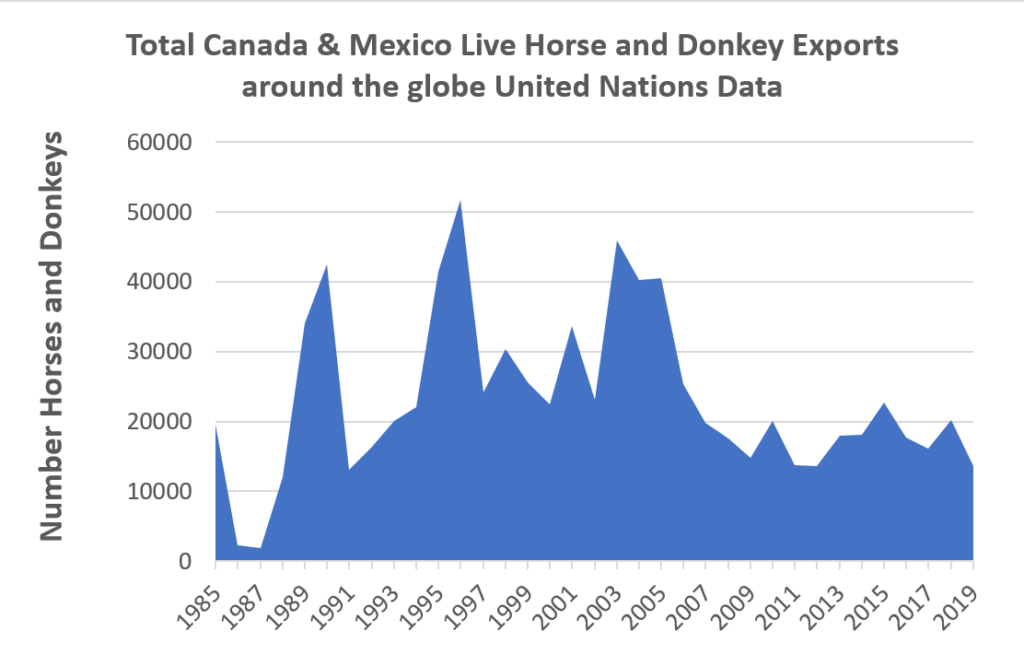
“Mexico is a trading partner with more than 50 countries, with agreements reaching into Europe, South America and Africa. Their trade partners also have partners.” The United Nations data above proves that Mexico is both slaughtering and shipping. They import an average of 97,210 horses/yr on average since 2007.
The Governor of New Mexico, Lujan Grisham is a former Congress woman and co-signer of the SAFE ACT. She could also Ban Equine Slaughter traffic through New Mexico by Executive Order Now and thereby close the NM border to Mexico and lead the way if need be!
President Biden is also a former co-signer of the SAFE ACT. He must immediately, Ban Equine Slaughter by Executive Order Now!
Please Contact President Biden & NM – Ask President Biden for an Executive Order to END Equine Slaughter including over US Borders
Please contact NM Gov. Michele Lujan-Grisham – Ask to her to END equine slaughter traffic through NM as did Illlinois. This will close the New Mexico Border.
I) PRESIDENT BIDEN + EMAIL https://www.whitehouse.gov/contact/ + CALL Comments: 202-456-1111Switchboard: 202-456-1414 + TTY/TTD Comments: 202-456-6213 Visitor’s Office: 202-456-2121 + USPS: The White House, 1600 Pennsylvania Avenue, N.W. Washington, DC 20500
II) NM GOVERNOR LUJAN GRISHAM (Previous SAFE Act Co-Signer!) + EMAIL https://www.governor.state.nm.us/contact-the-governor/ + CALL: (505) 476-2200 + USPS: 490 Old Santa Fe Trail Room 400, Santa Fe, NM 87501
[1] Canadian Horse Defense Coalition (CHDC) lawyer Rebeka Breder in Canada once again prepares to end Live Transport from Canada at an appeal hearing booked for January 24 and 25, 2022. https://canadianhorsedefencecoalition.org/, Flight Animals
[9] President Bush signed the Burns Act, President Obama legalized horse slaughter on American soil between 2011 and 2014 (see foot note no. 2), President Trump (see foot note 2), and President Biden has presided over the horrendous and Orwellian Path Forward round up plan, among other abuses, using Deb Haaland as Secretary of the Department of Interior (DOI) thereby scapegoating First Americans with this barbaric native American horse wipe-out and slaughter plan.
[12]Both U.S. political parties are culpable. However, not one U.S. presidents of either party since 2007 has utilized any political machinery or even an Executive Order to STOP this sinister horse slaughter industry. However, all have used Executive Orders when it suited them: Bush 291, Obama 276, Trump 220, Biden 96 so far! https://www.statista.com/statistics/1125024/us-presidents-executive-orders/
Complete Lip Service and Disrespect from our U.S.Congress A DISGRACE
MANY THINGS ARE MADE CRYSTAL CLEAR HERE, HOWEVER LETS FOCUS ON 2007 WHEN AMERICANS CLOSED ALL THE HORSE SLAUGHTER PLANTS AND CONGRESS THUMBED THEIR NOSE AT THEIR “CONTITUENTS SINCE THEN.
Posted inUncategorized|Comments Off on United Nation U.S. Horse Slaughter Data
Horse Slaughter is inhumane (1), unnecessary, and despicable to the American people. The end of American horse slaughter would also bring about needed change to the American wild horse program which the FARM BILL has largely blocked. This would finally necessitate on-range management of wild horses as wildlife as was intended by the American people for the last 50 years. Gruesome management by illegal helicopter round-up would no longer be sustainable because the secret outlet to enable the sale of these horses and donkeys as meat globally, through Mexico per data from the United Nations, would be closed, and MUST be closed.
The best and obvious model for wild horse management is Yellowstone National Park(2), which (like our wild horses and burros) is also under the Department of Interior (DOI) as is the Bureau of Land Management (BLM) and the funding for the USDA FS Wild Horse and Burro budget. Simply put, the native horses would be managed as wildlife alongside their native predators. Horses evolved in North America for 55 million years, some migrated over the Behring Strait throughout time. Some came back over that Strait throughout time, and some came back by boat! However, and somewhat unimportantly(3), no scientist has proven domestication. On the contrary, they have been proven both native and wild. To be clear, domestication is not taming or habituation. Domestication is instead a genetic change where familial structure is lost. Other genetic changes may also occur such as upright ears becoming lopped or hanging, tails curling, and brain size reduction, among others.
Due to cave paintings and DNA analysis, we know that there were Appaloosas as far back as twenty plus thousand years. There are also prehistoric cave paintings of Pintos and horses with long manes. Moreover, and over, and over, different “breeds” are not different species. There are reasons why horses did not need to be domesticated to work with us, and there are many different species that work together and help each other with or without even taming much less domestication.
Without natural predators the use of dartable contraception(4) can maintain the wild horse population. The model here is the Island National Park at Assateague without predators. It is a remote 45K acres. However, the FARM BILL’s influence has caused Congress to work duplicitously(5) against population management techniques that do not permanently sterilize the native horse, and that are not allowed for use on meat animals. They intend only for our native horse to continue to be slaughtered quietly, however brutally, over the borders for meat and this is the unspoken case on both sides of the aisle. This though enlightened Veterans, Advocates, and Ranchers are capable and have stepped up to dart remotely taking away Congressionally choreographed excuses though to little avial.
Note to Congress: There is needed, interesting and lucrative range work for rural “ranchers.” The FARM BILL must transition to educate; to heal our air, land, water; and to preserve our public lands and bio-diversity. Or it must finally be sunset, after 88 long years of continuous and gargantuan government subsidies causing ingrained (no pun intended), bipartisan, but not beneficial political influence.
Ranchers, wild horses, and native predators can all work together to benefit the ecosystem, if we dare to move forward together. We certainly can, and we must.
By Patience O’Dowd President Wild Horse Observers Association – (WHOA) Dec 18th 2021– 50 year Anniversary
Endorsed by Dr. Lester Friedlander DVM – President Citizens Against Equine Slaughter
ENVIRONMENTAL LAWS – Nixon Era
Fifty years ago, a Republican president Richard Milhouse Nixon gave us 1) the National Environmental Policy Act (NEPA), 2) the Environmental Protection Act (EPA), 3) the Free Roaming Wild Horse and Burro Act (WH&B)(6), 4) the Endangered Species Act (ESA), 5) Marine Animal Protection Act and 6) Marine Protection, Research and Sanctuaries Act.
The WH&B was signed into law on Dec 18th 1971(7), and disallowed our American wild horses to be slaughtered. After 50 years of bipartisan fraud and collusion in Congress (and NM State legislature), hypocritical horse slaughter continues over our U.S. borders funded by the FARM BILL => it is time to end that all NOW!
WAR ON NORTH AMERICAN NATIVE WILDLIFE
Three of five of the environmental laws referenced above were arguably passed in response to a long-term, undeclared war on North American native wildlife(8) and native flora.
To wit, American non-native domesticated bovine out-weigh(9), and outeat, American humans by two and a half times. Livestock’s feed consists mainly of annually and harmfully tilled mono-cultures comprising literally 70% of the crops we grow. This is literally wiping out our breadbasket’s underground ocean, the Ogallala Aquifer. Additionally, government agencies are allowing the spread of flammable non-native invasive flora on public lands turning the wildlands into agricultural grazing lands(10) . This agricultural invasion decimates natural habitat for wildlife.
Importantly, native wildlife includes many species such as game animals, native prey, and predators. It also includes non-game animals, those not hunted for their meat or pelts, such as wild horses which have been protected for 50 years, THEORETICALLY, by the 1971 Wild Horses and Burros Act.
ROOT CAUSE — CAMPAIGN FINANCE — FARM BILL CORRRUPTION
The FARM BILL(11) in 2021 is a whopping $86 billion per year. This has created a highly contagious and unnecessary conflict of interest between our federal and state law makers and our wildlife because it beckons kickbacks to support politicians who will support the subsides for the invasives which compete with and wipe out native wildlife. Importantly this source of tax payer dollars for the politician comes through the ranching community. There are many possible positive alternatives(12) to this for ranchers and wildlife.
This bipartisan Factory(13) FARM BILL isn’t only about farming. It has been in place and growing since 1933. No sunset in sight. Arguably, it has played a part in destroying our soil, air, and fresh water stores and recharge. However, it is all in look good Orwellian fashion(14). After the first Dust Bowl, we had an underground ocean of the Ogallala fresh water aquifer as a back-up, now we do not. But we hear of schemes to pump(15) fresh water all the way from the Great Lakes.
Due to FARM BILL influence, neither Congress nor our state governments have ended transport to horse slaughter over our borders while legislators and elected officials get direct and indirect monies through kickbacks. However, virtually all feign they are anti-horse slaughter as they know that to be openly pro-horse slaughter is political suicide given that 80% + in the US are strongly opposed, by independent Lake Research poll(16).
Recently, a well-known bipartisan scheme, called the Path Forward(17), was pushed and passed by Tom Udall (Democrat) which is a destructive and brutally illegal(18) wild horse helicopter round up plan. This is an over-the-borders-meat-scheme which Senator Udall planned, passed, and then he retired! This, though the Senator from New Mexico well knew that he had not ensured the borders were closed to horse-slaughter traffic before passing such a cruel and lucrative, for some, round up plan. This, although he had for many years superficially co-sponsored ending horse-slaughter traffic over our borders.
The media is in on all of this working to make slaughter relative to fake drought look attractive as they did at Cameron(19).
FACT: Per United Nations data, horses sent over the border to Mexico are then also sent on to slaughter around the globe.
Finally, it is important to understand that only 14 states have a state funded program for campaign finance which does come with certain conditions(19).
ENVIRONMENTAL GASLIGHTING by US Congress – MUST STOP
1) The horse is a native(20) North American mega fauna having evolved here for 55 million years. However, this native and iconic wildlife species has been unscientifically SOLD OUT in every sense of the word as a non-native, domesticated livestock species by many in Congress with a conflict of interest(21). It is important for all to know that domestication is a genetic change, it is not taming, nor is it habituation.
2) But why GASLIGHT Americans about the facts of one of our oldest native mega fauna? Because the powerful livestock industry funded by the FARM BILL does not want to compete with native predators for their cattle and does not want to compete with wild horses for grasses. Hence, the claim that wild horses are domesticated so that they can be managed as livestock rather than managed by natural predators as non-hunted wildlife. This, given that it is unacceptable to U.S. citizenry to hunt them. It is equally unacceptable to slaughter them as is currently happening.
3) Unintended Consequences: Our US native predators have been “managed” by hunting and trapping (almost to extinction) with unintended consequences for both the environment (reference Yellowstone National Park), and for our hunted native wildlife (reference Chronic Wasting(22) disease). The Solution: It is widely understood that Yellowstone(23) National Park was severely environmentally degraded until the natural native predators were re-introduced. This is what our public lands need, restoration of a balanced native trophic cascade as much as possible.
4) Currently Congress is allowing state governments to literally pipe streams/rivers underground for high pressure irrigation and allowing these rivers to be stolen from use by wildlife under the guise of efficiency, less evaporation, while not checking what wildlife they are harming as required statutorily(24).
5) Bison have been in North America approximately a mere 200,000 years from Asia, and the moose has been here from Europe only 10,000 years. This is no comparison to the amount of time horses evolved in North America. However, the non-native appellation is not given to bison or moose, as it is to the horse.
6) The graph above shows that Congress has refused to end horse slaughter even after Americans shut down horses slaughter in 2007. Other contempt of the law is also shown by this graph. The U.S. sends horses over the borders to Canada and Mexico who then send about 20,000 horses on to slaughter around the globe, also per United Nations Data.
ENVIRONMENTAL GASLIGHTING – NEW MEXICO – MUST STOP
Governor Lujan Grisham’s New Mexico Livestock Board (NMLB) is appealing WHOA’s Lincoln County District Court win for the horse as NATIVE!
1) NM Governor Lujan Grisham (Democrat) and Senator Tom Udall (Democrat) were both co-sponsors of the anti-horse slaughter legislation while in Congress. However, both have seriously betrayed this position, costing many sentient lives and suffering.
2) Once she became Governor of New Mexico, she jumped right into the fight against WHOA’s important legislative win which enacted protective legislation in 2007 for NM state’s wild horses. This legislative win was repeatedly upheld in the courts(25).
3) Not only has she NOT closed the border with Mexico to horse slaughter (which she could), she is also fighting WHOA’s ground breaking 2018 win for the horse as NATIVE.
4) She is also defending private property rights against free roaming legally wild horses; however, she allows 1.4 million cattle in NM to be a non-native, free-range, domesticated species, AND to have taxpayers pay for traffic safety corridors for these privately owned cattle!
New Mexico Legislature:
Senator Pat Woods (Republican) and Senator Brenda McKenna (Democrat) work sneakily at legislature, in Orwellian fashion, to wipe out New Mexico’s wild horses.
1) NM Senator Pat Woods has received over $1 million(26) from the FARM BILL. The writer has heard him make comments to the effect that even if managed such that births would equal attrition so that the population remained stable, there is no number of wild horses that should be allowed to roam. (Again, let’s consider the 1.4 million non-native, domestic, privately-owned, free-range cattle in this fence out state.)
2) Senator Brenda McKenna, a new NM State Senator, immediately joined with Senator Pat Woods in his work to overturn WHOA’s protective wild horse legislation carried by NM Senator Komadina MD(Republican) of 2007. Senator Brenda McKenna has worked with the current Secretary of the Dept. of Interior, Deb Haaland since at least 2013 and also as her Congressional Representative.
3) McKenna also attempted unsuccessfully to take down the Placitas Horses in 2 other bills in 2021 in addition to her work with Senator Pat Woods on his bill against the wild and native horses of Placitas, Lincoln County, and all New Mexico.
4) NM Senator Pat Woods has brought 2 other bills prior to 2021 trying to moot WHOA’s 2007 legislation and associated court wins which have been paid for by the citizens of New Mexico.
5) These corrupt actions are essentially, the FARM BILL versus the People.
6) New Mexico Legislature – Senator Pat Woods and Senator Brenda McKenna et al. : This a conspiratorial and serious conflict of interest, a mis-use of our public funding, an abuse of power, a travesty by theft of the people’s protected natural resource, horse theft, and is a dictatorial theft our due process in both the legislative and judicial branches of government, under color of law.
Please CALL and Write to demand this Hypocritical Horrendous Horse Slaughter end by Executive Order NOW!
I) PRESIDENT BIDEN EMAIL Email: https://www.whitehouse.gov/contact/
CALL Comments: 202-456-1111 Switchboard: 202-456-1414 TTY/TTD Comments: 202-456-6213 Visitor’s Office: 202-456-2121 USPS The White House 1600 Pennsylvania Avenue, N.W. Washington, DC 20500
13. Yes! The Farm Bill pays for slaughter houses and equipment: https://crsreports.congress.gov/product/pdf/R/R45525“. . .building fencing for livestock; purchasing and equipping slaughter and processing facilities.” Hence “Factory” FARM BILL.
16. 80% of Americans are anti-horse slaughter by independant Lake Research Poll. Americans are becoming very aware that abuse of animals and people are correlated in many studies now. Those without empathy are part of the human race, some are pro-social and some anti-social, however should probably not have jurisdiction over sentient beings.
18. Helicopter Round up affidavits by Dr. Lester Friedlander DVM Board Member of WHOA https://whoanm.org/wordpress/?p=494 and https://whoanm.org/wordpress/?p=509 Note that WHOA stopped Helicopter round-ups in New Mexico in 2004 at USDA FS and has worked to keep them stopped at the adjacent BLM. This by administrative appeal and protest at the Region 3 Office in Albuquerque.
19. WHOA Investigates Flagg Staff/Cameron border Az: 2018 The media did NO investigatory work into the quite apparently planned and monitored deaths of 119 wild horses. (This is not the first, and this is not the last. This is a government tactic to push puplic opinion toward slaughter as human versus drought. However, this is more akin to torture/murder) https://www.facebook.com/whoanm.org/photos/pcb.852079021880652/852077991880755/
20. Wild Horses as Native North American Wildlife by Jay F. Kirkpatrick, Ph.D. and Patricia M. Fazio, Ph.D. (Revised January 2010)https://whoanm.org/wordpress/?p=768
21. Unscientific and fraudulent revision of North Americas natural history: Agencies including the National Park Service and USDA Forest Service, literally do not include horses as North American Mega Fauna. Equally revisionist as well as non-statutory, the BLM, DOI literally call them livestock and the USGS calls them feral. This on our public payroll. Similarly, scientists also follow the FARM BILL grants payout at state run Natural History Museums, literally specimens of domesticated cattle previously Bos Taurus from Asia rather than provide one example of the rich archeologic equine history of the 55 Million years of remains readily available but hidden from view – like so much trashish.
22. North American deer, elk, and moose have been mismanaged without their natural predators and are spreading a prion called chronic wasting disease throughout this continent’s soils and grasses. https://www.cdc.gov/prions/cwd/index.html
25. Statutory Requirement to ensure piping water under ground will not harm wildlife under NEPA and 16 U.S. Code 662 Impounding,Diverting, or Controlling of waters (f) Estimation of wildlife benefits or losses.
26. Environmental Working Group (EWG) Data Base of FARM BILL subsidies https://farm.ewg.org/
Thanks to those in power without empathy (1) (2), who manipulate the American people on both sides of the aisle, gaining power and kickbacks from the $85.6 billion/yr {FACTORY} Farm Bill (All the give aways for school lunches and free food programs only create a market for their grizzly, unhealthy products which wipe out our wildlife and fresh water, in pretty packages). At the same time, amassing horse slaughter $$ from the NM border and others, as well as slimy political kudos from those they deceive, divide, and attempt to conquer, all while happily and illegally harming both sentient homo sapien and sentient equine.
Meet ex-Senator Tom Udall as always gas-lighting as the “out door guy”, he set up an Indigenous person to take the fall however willing Deb Haaland has been to silently usher in his PathForward massive round up to slaughter plan and be the face of it. Can you say Indian Scape Goating?
Here in New Mexico where everyone is supposedly a SAFE ACT CoSponsor (a Congressional Bill to close all US Borders to horse slaughter) including current Governor Michelle Lujan Grizzly Grisham who both refuses to close her OWN New Mexico Border to Horse Slaughter but is also fighting WHOA’s win for the Lincoln County Wild Horses of Alto and Ruidoso.
Ex Congressional Representative, Governor Michelle Lujan Grisham and Ex Senator Udall PUSHER of the meat market plan called the Path Forward, are pro-slaughter and quite Orwellian, and disengenuous.
However, they gladly accepted KUDOS and political insurance for being FALSE SAFE ACT Co-Signers for years.
REMEMBER THE LIE IS PROTECTED IN COMMITTEE AT CONGRESS AND
AT STATE LEGISLATURES
BUT SENTIENT BEINGS ARE NOT
North American Continent – Horses evolved here for over 55 million years while Bison migrated here only 200K years a go. Look it up! 🙂
THIS STORY IN BRIEF: The Path Forward and the Big GonaCON is a slippery story of wild horse wipe out for USDA approved meat. GonaCON is a wild horse sterilant developed by the government with an adjuvant preapproved by the USDA for use in food animals. The government also developed a darting machine for use with this sterilant which also imbeds a micro chip, thereby ending the use of sometime life saving identification by freeze brand.
The well known contraceptive PZP which does not easily or necessarily sterilze, is purposefully not allowed for use in this darting machine and it is not approved for use in food animals due to mis-categorization as the government does not want the horses managed at any level of population. They want them as meat or gone.
Step1: Create a hormonal sterilant (Gona-CON) that effectively sterilizes both Stallions and Mares. (Stallions in one shot loses harem stallion role in 6 mos.)
Step 2: Ensure the USDA will allow Gona-CON’s use in food animals or meat market.
The liquid carrier for a vaccine which boosts immune response by making the body think there is an issue using dead parts of a bacterium etc., but is non-disease causing, is called an adjuvant. The government, which has developed Gona-CON has worked to ensure that the adjuvant for Gona-CON is accepted for use in food animals. See page 2 of this link which states
The tricky EPA label states “Do not apply this product to food or feed.” meaning not to put Gona-CON “on” food (see last link in Step 1), to imply it is not made for use in food animals, however, it is. https://www3.epa.gov/pesticides/chem_search/ppls/056228-00041-20151119.pdf Also, see first page, the USDA-APHIS is the owner of this patent.
Step 3: Create a Remote Control Darting Machine (developed with the government at NMSU).
This machine can dart three horses at once in the chest (FRONT) while eating side by side at feeding stations. This machine also inserts a chip to track who is already sterilized. Remote/machine darting is important because this hormonal sterilant GonaCON, is not safe for humans/women to handle.
Reportedly, the cost is $100,000 per machine.Hence, the $11 million for “contraception” which was recently approved by Congress and was advertised (by those who drink the Kool Aid, or have a conflict of interest), as a WIN for wild horses. This will buy about 50 to 100 of these machines.
Step 4: BLOCK the use of non-hormonal and non-sterilant contraception PZP(1) in this Darting Machine.
Porcine Zona Pellucida called PZP (1) was developed by a non-governmental organization (NGO) (2) (3). HSUS owns the PZP patent though HSUS did not develop it and does not manufacture it. However, HSUS has reportedly disallowed PZP to be darted from the chest (front) thereby tacitly allowing ONLY the government’s sterilant, Gona-CON, to be used in government’s Remote Control Darting machine.
Our native horses and burros are almost gone, despite mainstream media misinformation which also virtually never mentions the 93 million non-native cattle (which outweigh us and out eat us in this nation) vs approximately 0.05 million wild horses in the US . Cattle are also about 1/3 larger than they were 50 yrs ago due to genetic manipulation and 70% of crops we grow, which uses up most of our fresh water, is fed to livestock and both are sent overseas for $$! We don’t even have 1/10th of a million wild horses in the entire US.
Citizens Against Equine Slaughter (CAES) in Oregon has caught the BLM attempting and performing round ups on our native wild horses without the required environmental (NEPA) review and notification of interested parties, as part of their 10-year plan, “The Path Forward” (see Step 5, below). For this and other reasons, we have filed Appeals with the Interior Board of Land Appeals. CAES has also caught and stopped the use of GonaCON at an HMA in Oregon without inclusion in the NEPA process. These 10 year plans are their liscense for fraud behind the curtain.
(1) PZP is disallowed for use in food animals per it’s EPA label http://(3) PZP is disallowed for use in food animals per it’s EPA label https://www3.epa.gov/pesticides/chem_search/ppls/086833-00001-20170706.pdf because it’s adjuvant though not disease causing can give false positives for TB due to it’s ability to also protect an animal from being infected with TB. https://www.jstor.org/stable/20096515. This is because an adjuvant called Freund’s Adjuvant though not disease causing can give false positives for TB due to it’s ability to also protect an animal from being infected with TB. https://www.jstor.org/stable/20096515 However, PZP uses only modified Freund’s adjuvant and Freund’s incomplete adjuvant which do not give false positive results for TB. https://www.sccpzp.org/pzp/faq/
(2) Science and Conservation Center, Billings Montana, which sells this contraceptive at a loss for a very low price about $25/ vaccination. https://www.sccpzp.org/pzp/faq/ No one is gettin rich here.
(3) PZP: Porcine Zona Pellucida contraceptive has been used successfully without the need for one round up, or one adoption, for over 30 years at Assateague National Park (over 45,000 acres most of them very remote as verified on google maps!). https://www.nps.gov/asis/learn/nature/resource-brief-horses.htm
Step 5: Congress Passed the “Path Forward”, a 10-year illegal, disgraceful helicopter roundups and sterilization plan in just ONE congressional session.
The Path Forward delivered us straight to Hell. With helicopter stampedes and being sent to slaughter around the world (through Mexico per the United Nations report, as has happened through time). What’s left of us will lose our families thanks to the Gona-CON.
“PATH FORWARD”: US Senator Tom Udall planned and announced his retirement on March 25th 2019. Six months later on October 2 2019, the PATH FORWARD was passed and ASPCA gave Tom Udall ALL the credit via email announcement (see picture above, with emphasis added) for PUSHING and successfully passing this disgraceful path to extinction in ONE Congressional session. Tom Udall thereby set up an Indigenous Secretary of the Interior, while he himself, stepped aside.
Cruelly, Tom Udall had neither the Canadian border nor his own NM border closed to horse slaughter transport before passing this huge round up and sterilization plan, cynically called the Path Forward. As a multi-year sponsor of the SAFE ACT (1), which would close the borders to horse slaughter, he well knew the consequences of this plan and of the slaughter it would cause.
Cruelly Again, Tom Udall did not end the inhumane and therefore illegal federal helicopter round ups before passing the Path Forward. (2).
(1) SAFE ACT: This Congressional bill would end American Horse slaughter by disallowing horses to be sent over our borders to be slaughtered in other countries. It has been introduced in various forms since 2015 and it generally has approximately 200 plus co-signers, yet never moves significantly. What do we see, empathy or excuses? This lets us know who is in office. https://www.congress.gov/bill/117th-congress/house-bill/3355/all-info
(2) Likewise, after many years of sponsoring the SAFE ACT as a NM Congress person, Michelle Lujan Grisham (Democrat) became a NM Governor but has not closed the NM border to horse slaughter, as neither did stated anti-slaughter Governor Martinez (Republican). This alone limits their access to the presidency but makes it clear who is running the government, and it’s neither party.
Step 6: American politicians without empathy know that they cannot openly support horse slaughter in the US. Their Answer? Scapegoat the Indigenous!
Politicians have been disgustingly working to scapegoat the Indigenous for horse slaughter in NM since as early as 2007 and after, even dumping horses on tribal lands to try and push them towards slaughter and working towards a horse composting center for federally wild horses in holding pens, calling it “triage” (much info. available upon request). Utah has also been caught up in this effort to PASS the HAT of slaughter off on the Indigenous. (See pics below from the governmentally attended Salt Lake City, Utah Slaughter Seminar Agenda in 2017. Courtesy CAES inspection of public records request (IPRA) to Governor Gary Herbert’s office.)
Salt Lake City Agenda 2017 “. . . removing the rider, transfer to tribal authorities. . .”, “transfer the horses as quickly as possible?”
Deb Haaland, Secretary of the Interior.At Deb Haaland’s pueblo, the Laguna Pueblo, there is no definition of a wild horse. All unowned horses are defined as estray livestock. The Laguna Pueblo hired the previous executive director of the New MexicoLivestock Board (NMLB) Robert Alexander as their Range Management Specialist and he has testified for the NMLB in court against Wild horses and WHOA (and lost) and for Senator Pat Woods at the NM legislature, who has brought numerous NM State bills against NM’s legally wild horses (1) in an attempt to eradicate them as estray livestock.
Moreover, Deb Haaland’s Congressional Field Representative and long time associate since at least 2013, Brenda McKenna, now NM Senator McKenna, is also working with Senator Pat Woods and co-sponsoring anti-wild horse bills (SB 385 of 2021) and other bills to wipe out NM’s state wild horse protections, infavor of private property rights (2). Senator McKenna’s signature ploy is much like that of Utah’s Chris Stewart, she trickily feigns care and safety concerns while doing absolutely nothing for road safety in the Rocky Mountain wild life corridor of the Sandia Moutain. While at the same time, she works to remove protections from round ups in favor of private property rights, though New Mexico is a fence out state for the 1.4 million non-native cattle. It is a fence out state for wild horses also, as WHOA has proven in court. This is what McKenna wants to change, so that property owners can call the NM Livestock Board or any Land Grant, or any other political subdivision of the state to round up wild horses (and specifically the 91 to 95% Spanish Wild Horses of Placitas in her new district), off anyone’s private property, rather than have to put up a fence like they/she would for the 1.4 million free range cattle of her state.
So where does Deb Haaland stand? Who is she really representing? Ask her. She has been loudly silent during these massive and brutal helicopter round ups. Many federally wild horses in Oregon alone have been round up without public notice with all kinds of horrendous injuries for which many have been euthanized.
(1) Ground breaking legislation was passed in NM in 2007 for state’s wild horses won by WHOA and Senator Komadina MD. which WHOA has upheld in court. NMSA 77-18-5. See whoanm.org for 3 court decisions.
(2) There have been 8 bills attempting to undo these protections and one of them in 2021 was even literally against another Pueblo is pro-wild wild horse and the Indian Affairs committee was literally lied to, but Senator McKenna voted for this bill which was killed later. Most of these bills have been by Senator Pats Woods (3) since 2017 after the WHOA court wins, and now Senator Brenda McKenna has joined him in 2021 with Senate Bill 385 (SB385). Here is just one of the duplicitous and misleading to the point of being fraudulent bills: SB126 https://www.youtube.com/watch?v=kg6ata_bvc8
(3) Senator Pat Woods is the recipient well over $1 Million from the infamous kick back source the Farm Bill. He uses his legislative position to steal our natural resources. Shouldn’t he be happy enough with this pocketfull of free $$$. See EWG working group.
Step 7: Allow the illegal Helicopter Round-ups in the Media/News! Of course! So that Americans can be rightfully appalled at Helicopter Round ups and instead support their sterilization by GonaCON as “humane”.
Helicopter round ups are now in the news, as they have never been since 2004 (1). WHY? They want people to push for Gona-CON as a “better” alternative to helicopter round ups, rather than other, much better alternatives such as PZP. The other humane issue, the Elephant in the room, is slaughter over the borders, which they sleazily refuse to stop. Their sleazy final solution is Gona-CON, the a sterilant that can be used on “food” animals and couched as a “humane” contraceptive, though it will destroy the very family structure that has allowed wild horses to survive millenia.
Two former “HSUS” staffers were at the front of the “anti-helicopter media”. They were hiding behind two new Utah groups with good sounding names. However again, now the use of a sterilant, Gona-CON, can be advertised as a kindness though seemingly an integral part of a disgusting and sleazy plan.
(1) WHOA stopped the helicopters at the USDA FS Carson National Forest through mediation of their Administrative appeal and a huge protest at the Region 3 USDA FS bldg. in Albuquerque, NM. Much media attended, TV stations, radio stations. The Helicopter round up was stopped right in the middle of the round up. After that, the media would only do stories on abandoned and abused horses rather than wild horses or slaughter. This is literally what many reporters have told WHOA. http://whoanm.org/HorseTerritoriesProject/Deadly%20Roundup%20Protest.htm
Step 8: End Freeze Brands and instead use chips compatible with the Automatic Darting Machine.
“Regional Office The Regional Office (RO) purchased 1,000 equine microchips (840 ISO standard 134 MHz). These microchips will replace freeze branding and use of the BLM identification system and meet the 9 CFR requirement for individual animal identification from point of origin. Each horse’s microchip is being registered in the National Equine Registry. The RO has developed a close working relationship with New Mexico StateUniversity on wild and feral horse issues in the State, as well as working with the Tribal Nations in the Southwestern Region . . .”
Yes of course, NMSU developed the Gona-CON darter which uses CHIPS!
In Conclusion
This is cruel, without empathy, and fraudulent. This is the destruction of our Natural Resources and collusion in doing so. This is all against our American culture. Our government has spent 50 years secretly and fraudulently working to exterminate our wild horses, while pretending they are not native and pretending to care while slaughtering them. This is clear.
The BLM is run in each state by that state’s Congressional Representatives. That’s why their web pages tell us to come to them for help with any federal agency. However, the elected officials hide how much money they receive from the Farm Bill through kickbacks from the large corporate ranchers or directly to themselves as in the case of NM State Senator Pat Woods and other public officials. The Farm Bill has been around since 1933, it is gigantic, and makes it very hard for citizens to compete for representation from their federal and state representatives.
Suffice it to say that a number of excellent management alternatives are available to the government. However, their only long term plan is native wildlife extinction as well as native flora extinction. This plan in and of itself, is illegal and unreasonable.
These politicians of Congress, and their pawn agencies, have never, ever, wanted these horses actually managed on the range like at Assateague or by their native predators (1). If they had wanted that, they would have done this since 1995. Management by round-up every 4 years is not management, it is meat. (2). PZP ends the meat, without easily wiping out the wild horses. These two end games are their ONLY plan. Easy meat or gone.
(1) Management by native predator of course works too, but native wolves, cougars, and even Bob Cats are also wiped out by cage traps and worse, while their pups and kits die of starvation. No empathy. Why? Again, to protect the meat industry and the 70% of crops grown in the US that feed it’s non-native livestock (Corn, Soy, Alfalfa, Wheat, Sorgum etc.). Not to mention all the mined water which that takes.
(2) The probability that any wild horse lives its life out on the range with their family is effectively zero with round-ups every 4 years. This is a livestock plan, a meat plan. Americans have continuously fought this so hard, Congress is now hiding behind these 10 year scenarios, like the Path Forward followed by (and along with) extirpation by GonaCON for more meat and gone. No empathy.
Some time in their short valient lives (10yrs or less due to cruel and arbitrary “sale authority”), they and their families will seperately become meat over our borders via a horrific and deathly stampede round up of new borns, foals, old, injured, pregnant, and their desperate stallions, working so valiently to defend them. With no transparency (no cameras on the helicopters, these family members also go to their deaths on the run, left behind.) No empathy.
By Patience O’Dowd
Endorsed by Ron Toahami Jackson
Posted inUncategorized|TaggedGonaCON, North American, wild horse|Comments Off on Breaking News: Gona-CON and the “Path Forward’s” – Eight Sleazy Steps to Wild Horse Extinction in the US
The Wild Horse Observers Association (WHOA) is a public 501 c3 non-profit corporation.
To make donations:
Or send checks to:
Wild Horse Observers AssociationPO Box 932Placitas, NM 87043
Alternatively, you can help WHOA by making any of your Amazon purchases through this search widget (4% goes to WHOA):